
Our Verdict
Great TV for mixed usage. Picture quality, Input lag and motion all perform very well, almost everyone will have a great experience with this TV.
- Deep blacks
- Bright, which is good for HDR
- Very fluid motion
- Picture quality deteriorates at an angle
Very good movie performance. Deep and uniform blacks aided by the good local dimming give an excellent picture in a dark environment.
Good TV show performance. The X900E gets quite bright and doesn't reflect light much. It remains enjoyable both day and night.
Great TV for sports. The colors are uniform so there won't be blotchy fields, and motion is very smooth.
Great TV for video games. The TV is responsive and has very fluid motion. Gamers will be very pleased with the X900E.
HDR movies look great on the X900E. The TV gets quite bright and can display saturated colors. Blacks are nice and deep as well.
Excellent HDR Gaming performance. The TV remains responsive even with HDR games, and the picture quality is equally good.
Good PC monitor. Mouse movement isn't delayed much and motion is handled well but the picture deteriorates at an angle causing the edges to darken when sitting close.
Changelog
- Updated Jun 12, 2018: A note for Xbox One X and Xbox One S owners: 1080p @ 120 Hz from the Xbox is only supported on this TV when the Xbox's connection type is changed from Auto-detect (Recommended) to HDMI, but unfortunately in this mode 4k and HDR aren't supported.
- Updated Mar 12, 2018: Converted to Test Bench 1.2.
- Updated Dec 11, 2017: Google Assistant has now been added to Android TV on Sony TVs, and it brings a lot of new features to the voice control. The remote score has been increased to reflect the new fuctionality.
- Updated Nov 10, 2017: Retested input lag with the latest firmware (PKG6.2669.0070NAA); there was no significant change.
Check Price
Differences Between Sizes And Variants
We tested the 55" (XBR55X900E). For the most part, we expect our review to be valid for the 49"(XBR49X900E), 65"(XBR65X900E), and 75"(XBR75X900E). Unlike the other sizes, the 75" variant has an internal power brick.
If someone comes across a different type of panel or if their Sony XBR-55X900E doesn't correspond to our review, let us know and we will update the review. Note that some tests such as the gray uniformity may vary between individual units.
| Size | Model | Alternative Name | UK Model |
| 49" | XBR49X900E | XBR-49X900E | KD-49XE9005 |
| 55" | XBR55X900E | XBR-55X900E | KD-55XE9005 |
| 65" | XBR65X900E | XBR-65X900E | KD-65XE9005 |
| 75" | XBR75X900E | XBR-75X900E | KD-75XE9005 |
Popular TV Comparisons
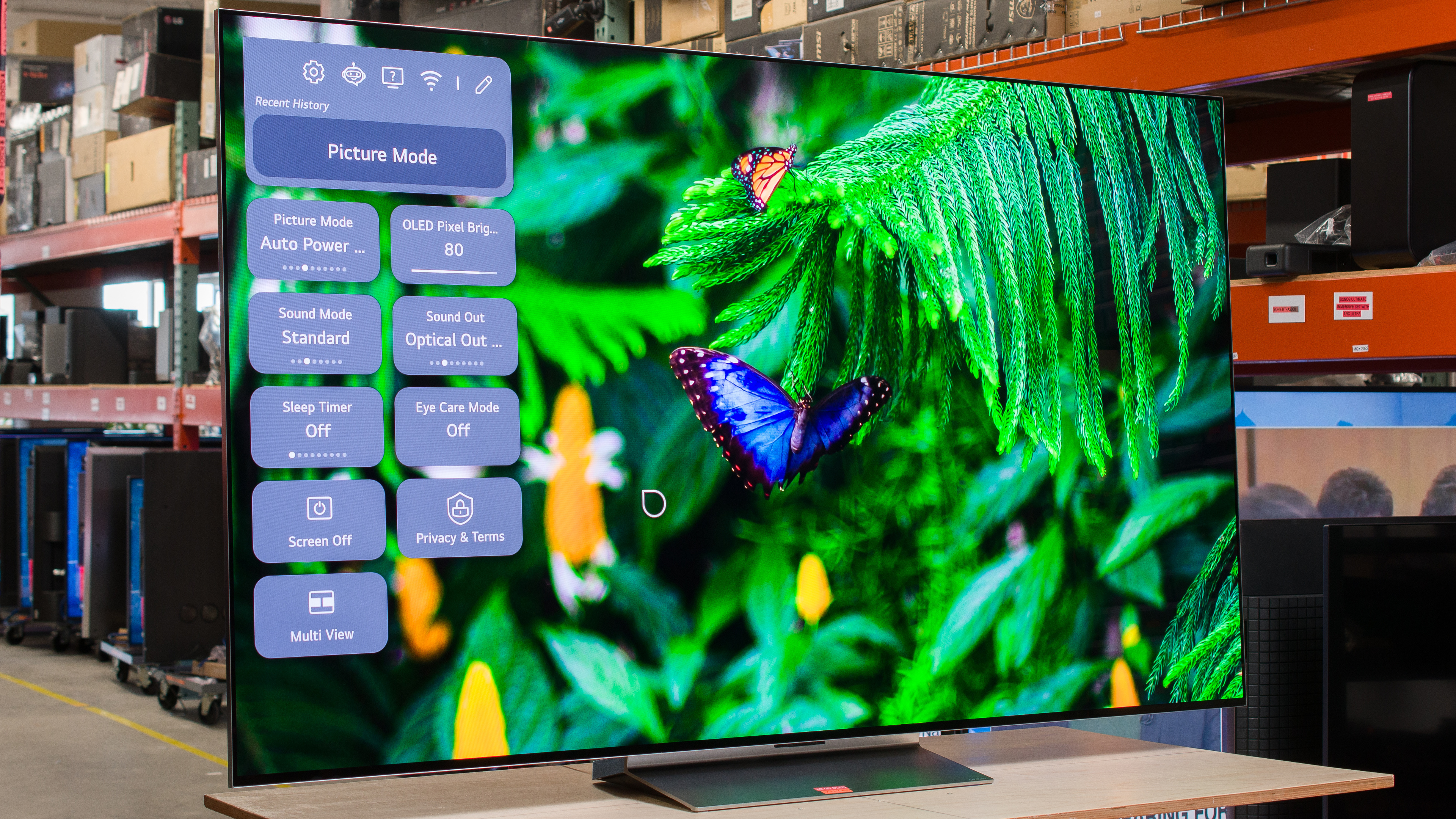
The Sony X900E offers a compelling package that is very competitive considering its price point. Picture quality is great, and its local dimming is a strong selling point. See our recommendations for the best TVs and the best 4k TVs.
The Sony X940E and X900E are very similar and offer nearly identical performance. The X940E has better dark room performance due to the improved local dimming feature and better black uniformity. The X900E has a much better response time and motion looks much smoother with very little motion blur. The X940E has been updated with support for Dolby Vision.
The Sony X900E is much better than the LeEco Super4. The X900E is brighter and has better reflection handling, making it a better choice for a well-lit room. The X900E has a local dimming feature that improves dark room viewing, and the X900E can remove judder from all 24p sources.
The Sony X900E is better than the Samsung Q7F/Q7 QLED 2017. The X900E is brighter than the Q7F and has a better local dimming feature, which is great for movie lovers. Both models have excellent reflection handling, but the Samsung Q7F is better. The Samsung Q7F has a better color gamut and volume, and movies look closer to the content creator's intent.
The Sony X930E is slightly better than the Sony X900E. The Sony X930E has marginally better input lag when sent a 4k @ 60Hz + HDR input signal and can also decode a Dolby vision signal, and this is great if you play HDR games. The Sony X930E has slightly better SDR peak brightness which makes it suitable for watching TV shows in a brighter room and also has better local dimming which improves picture quality when you watch a movie. On the other hand, the Sony X900E has a slightly better response time that will please gamers.

We buy and test dozens of TVs yearly, taking an objective, data-driven approach to deliver results you can trust. Our testing process is complex, with hundreds of individual tests that take over a week to complete. Most of our tests use specially designed test patterns that mimic real content, but we also use the same sources you have at home to ensure our results match the real-world experience. We use two main tools for our testing: a Colorimetry Research CR-100 colorimeter and a CR-250 spectroradiometer.
Test Results
Older Test Bench: We tested this product using an older TV test methodology before a major update. Some of the test results below aren't directly comparable with other TVs. Learn more
for pictures & test results

The X900E has a very typical Sony design, with a small stand that supports the TV well and a very functional appearance. There are slots at the rear of the stand for cable management, but overall the design is quite minimalist.
for pictures & test results

The metal stand supports the TV well and is very stable. It looks good, especially due to the tracks in each rear leg for cable management.
Footprint of the 55" TV stand: 10.2" x 19.8"
for pictures & test results

The back of the TV is very simple, with metal and plastic panels. If wall mounted, some of the ports may be difficult to access.

for pictures & test results

The TV has an average thickness. If wall mounted it may stick out a bit, but this isn't too much of an issue.
for pictures & test results
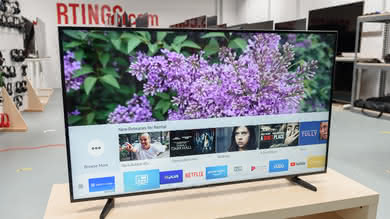
The X900E is a fairly cool TV, and should never feel hot to the touch. However its power brick does get warm, up to 45 °C, though this isn't hot enough to cause any problems.
for pictures & test results

The build quality is very good, all of the parts feel secure. The construction is very good with screws used to ensure good support.
for pictures & test results

The native contrast ratio is very good on this Sony TV. With a ratio of around 5400, this is much better than the X930D. A high contrast ratio is crucial for good dark scenes performance while watching movies in a dark room.
Note that this test is done in SDR with local dimming off to showcase the true native contrast of the panel used in this TV. With local dimming set to high with the same test pattern, the contrast ratio was around 6500 with black level of around 0.015 cd/m², which is even better.
for videos & test results

The local dimming feature is average on the Sony X900E. When set side by side with last year's X930D, it is clearly an upgrade visually, and we recommend it for normal viewing. When set to maximum it can sometimes feel a bit aggressive. If you visually see that it too aggressive, you can set it to medium or low.
Excellent SDR peak brightness. With both 'Auto Local Dimming' and 'X-tended Dynamic Range' set to 'High', the X900e is able to make small areas like our 2% window very bright. The TV can't brighten larger areas as well as smaller areas but large areas are still very bright. The TV is able to maintain this high brightness indefinitely which is good.
Good all-round brightness. Even the worst cases such as sustained 100% window remain very bright. With 'Auto Local Dimming' and 'X-tended Dynamic Range' set to 'High' the X900E is able to make small areas very bright, and maintain this high brightness over time without fading.
for pictures & test results

for pictures & test results

The overall gray uniformity of the X900E is good. The 50% standard deviation is a bit higher than what would be considered a good value, and this is cause by the darker corners and the general unevenness near the frame of the TV. Luckily for sports fans there is not too much dirty screen effect, as the center of the display is pretty even.
As for the 5% uniformity, besides some brighter areas near the bottom corners there is not much to complain about which is great.
for videos & test results
for pictures & test results
for pictures & test results
for pictures & test results
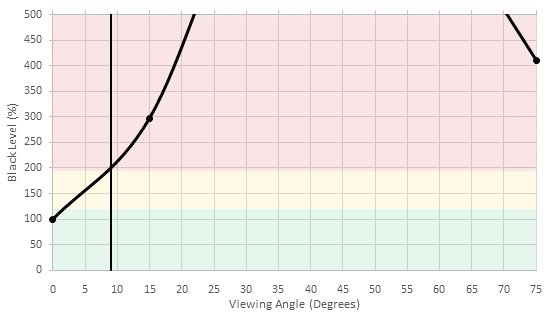
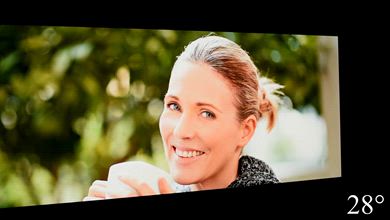
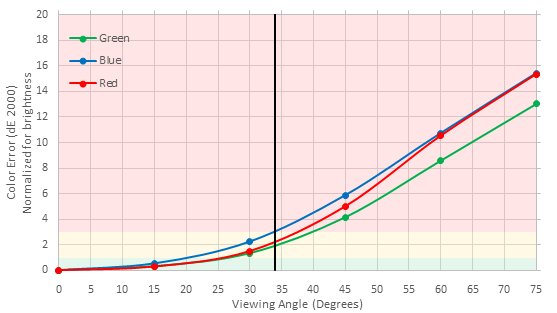
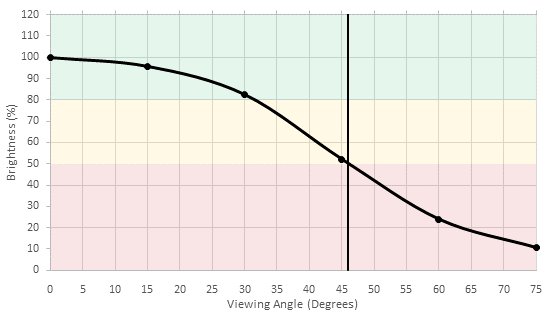
This viewing angle is bad, but is fairly typical for a TV with a VA panel. When sitting to the side of the TV and viewing it on an angle, blacks will look gray and colors will look washed out, though the brightness will stay fairly constant.
for pictures & test results

for pictures & test results

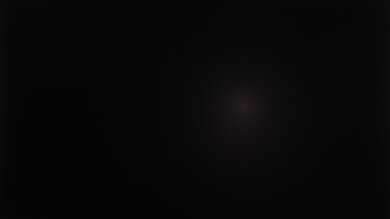
The X900E native black uniformity (whitout local dimming) is good and is similar to last year Sony X930D. Some clouding can be seen, especially near the corners, but with a standard deviation of 1.203, this is still a pretty good result.
With local dimming turned on, the result is equally good with a value of 1.014. This is a good sign that the local dimming is working well on the X900e
With local dimming turn on and with regular content, the faint clouding visible on our picture should not be noticeable.
for pictures & test results

for pictures & test results
for pictures & test results

The TV is great at handling reflections. The semi-gloss finish helps to diffuse light on the screen which reduces the intensity. Even in a fairly bright room, reflections aren't an issue.
for pictures & test results

for pictures & test results

for pictures & test results

Out of the box in the 'Custom' picture mode the calibration of the TV is excellent and could be used without any further adjustments. The white balance is slightly too warm, but even then the white balance dE is only 2.15 which is still a good score. The color accuracy is also good, with only the green tracking a bit worse than the other colors.
for pictures & test results

for pictures & test results

for pictures & test results

Calibration of the X900E is very easy and fast to do with the provided 2 and 10 points white balance calibration. The white balance was quickly brought to a negligible 0.25 dE, and the gamma curve was flattened to track more closely to the 2.2 value. The color space dE was brought down a bit, but since there is no color space management on this TV, we could not bring it down further. In any case, with a dE of 1.97 it is still an excellent result that is well under our good value of a dE of 3.
You can see our recommended settings here.
for pictures & test results

Upscaling of low-quality content such as DVDs is good. Details are preserved, but lines appear jagged. Very little haloing can be seen.
for pictures & test results

720p content such as cable looks good. The image is clear, but some moiré from the camera can be seen in the image.
for pictures & test results

Upscaling of 1080p content such as Blu-rays is very good.
1080p content is handled differently from most TVs. Find out more in our Additional Review Notes.
for pictures & test results

Native 4k content is very clear, and no issues can be seen.
for pictures & test results
for pictures & test results
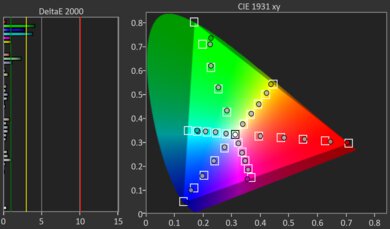
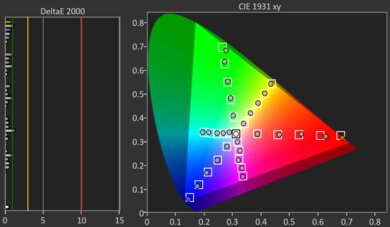
The X900E has a wide color gamut which is good for HDR content. Overall, deep colors will be well represented but the TV underperforms when reproducing greens.
for pictures & test results

for pictures & test results

The X900E has decent color volume. It is able to show its wide color gamut at a range of brightness values, though it does struggle at the extreme ends of this range. Its color gamut for extremely bright colors is smaller than at moderate brightness, and its blue tinted black level also prevents it from accurately showing very dark deep color.
for pictures & test results
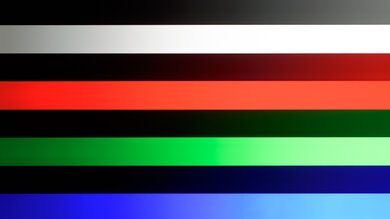
The performance of this TV is excellent when displaying our gradient test image. Small imperfections can be noticed in the dark green and blue, but these are almost negligible. The TV can display gradients without any banding normally seen on an 8-bit panel and should provide excellent color reproduction, especially in sky scenes for HDR movies.
for pictures & test results

The Sony X900E has some image retention, which is pretty unusual for a TV with a VA panel. The retention is really faint and not as strong as seen on some IPS TVs. It is the first time we've seen image retention on a VA TV. Note that image retention is not a deal breaker in any way, but more a temporary annoyance, since it is not permanent.
Update 10/05/2017: We have retested the image retention on our replacement unit (see here) and there is only very faint retention. The result has been updated, but note that there may be some variance on a unit-by-unit basis.
We don't expect VA panels to experience permanent image retention, as the VA panel in our long-term test appears immune.

for pictures & test results

for pictures & test results
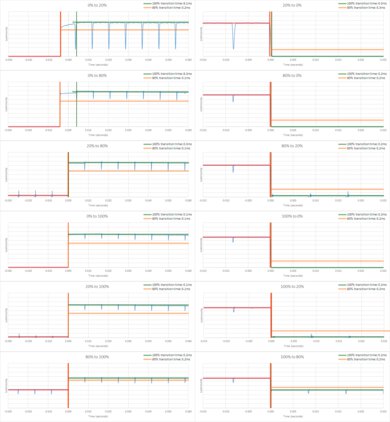
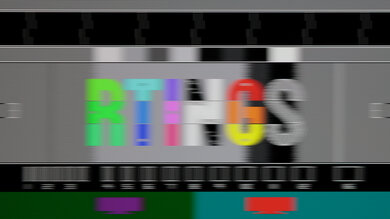
The response time of the X900E is outstanding and results in only a short trail following moving objects. The 20%-80% and 80%-20% transitions take a bit longer than ideal, resulting in the blur visible in the moving logo image. Overall, this TV shouldn't have any problems with fast-paced content.
for pictures & test results

The backlight does use PWM to dim, but only at very low backlight levels (at a setting of 8/50 or below). It flickers at a relatively high frequency of 720 Hz so content appears quite smooth.
Update 04/18/2018: Note that with 'Local Dimming' and 'X-tended Dynamic Range' enabled, the TV always flickers (no matter the 'Brightness' setting.
for pictures & test results
for pictures & test results
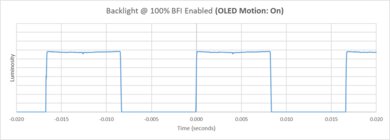
It is possible to reduce the flicker frequency to 120Hz by increasing the 'Motionflow' -> 'Clearness' slider. This does help to clear up motion, but not as well as the 60Hz flicker available on other TVs.
for pictures & test results

for pictures & test results

The TV has a 120Hz panel and is able to interpolate lower frame rate content to produce a very strong 'Soap Opera Effect' (SOE). To do so, adjust the 'Motionflow' setting and increase the 'Smoothness' slider. The 'CineMotion' option changes the threshold for interpolation. Set it to 'High' for the most SOE.
The Sony X900E is decent at displaying content smoothly, but for low frame rate content such as movies it does appear a bit stuttery, especially for wide panning shots, as each frame is static for ~30ms during periods of motion. For 60 fps content motion is smooth.
The X900E can play movies from Blu-ray players, native streaming apps and cable/satellite boxes without any judder. Note that when playing the movie from a 60p/60i source like cable TV, the 'Motionflow' option must be set to 'True Cinema' and 'CineMotion' set to 'High' to have a judder-free experience without any motion interpolation.
The X900E doesn't support variable refresh rate features such as HDMI Forum VRR or FreeSync.
Very good input lag overall. In game or graphics mode the input lag is always lower than 35 ms, which should be good enough for all but the most competitive gamers. Outside of game or graphics mode though the input lag is quite high, making this TV unsuitable for gaming with interpolation enabled.
Update 05/23/2017: The TV has been retested after the update to Android TV 7.0 Nougat, and the input lag is unchanged.
Update 07/18/2017: The TV has been tested with the newest firmware update (PKG6.2648.0065NAA). The input lag remains the same.
Update 09/20/2017: Tested 1080p @ 120 Hz input lag using our new input lag tool. It is much faster than the 1080p @ 60 Hz input lag, likely due to the TV bypassing some processing when it detects such an unusual signal.
Update 11/10/2017: Retested input lag with the latest firmware (PKG6.2669.0070NAA); there was no significant change.
This TV supports all of the common input signals. Only HDMI inputs 2 and 3 are capable of showing 4k @ 60 Hz @ 4:2:2 or 4:4:4 color, and only when 'HDMI Enhanced Format' is enabled. 4:4:4 color is supported in both game and graphics mode.
Remarkably the TV also displayed a 1080p @ 120 Hz input without showing the vertical line artifacts seen on the X930D. However when displaying this resolution while in game or graphics mode only crude upscaling was done on the 1080p image, so the image looked almost as jagged as it would on a 1080p TV. Some people may prefer this look however because it retains most of the sharpness of the original image.
Update 06/12/2018: A note for Xbox One X and Xbox One S owners: 1080p @ 120 Hz from the Xbox is only supported on this TV when the Xbox's connection type is changed from Auto-detect (Recommended) to HDMI: (Xbox > Settings > Display & sound > Video fidelity & overscan > Display > Connection > HDMI). Unfortunately in this mode 4k, HDR, 50 Hz and 24 Hz aren't possible, so this mode is only recommended when the higher refresh rate of 120 Hz is more important to you than these other features.
Update 06/18/2018: Correction, 24 Hz and 50 Hz are in fact possible with the Xbox's connection type set to HDMI.


There is a shared component/composite port on the back, and an additional composite input on the side but an adapter is not included. An example of the correct adapter can be found here.
To enable audio passthrough, in the 'Action Menu' change the 'Speakers' to 'Audio System'.
This TV does support a variable analog audio out, which means you can control the volume of wired headphones (like the Beyerdynamic DT 770) directly with your TV remote.
for pictures & test results

Poor frequency response. Low-end cutoff of 160Hz means that this TV won't produce much bass. Additionally, even though this TV doesn't get very loud, pumping and compression is produced as the volume is increased.
for pictures & test results
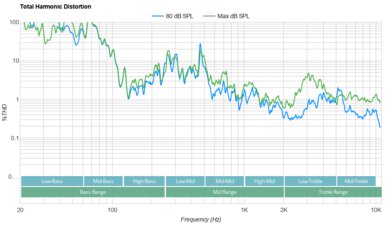
Poor harmonic distortion performance. The overall amount of distortion at 70dB is very low, however, just like most of the other Sony TVs we've measured, there is a big spike in the overall harmonic distortion as volume is increased and the TV is put under heavier loads.
for pictures & test results

The Android TV interface isn't as easy to use as some other smart platforms. On this TV it also sometimes has lag and choppy animations. The remote's 'Action Menu' button helps to alleviate this by providing a quick menu with common functions and settings.
The main interface of the TV has no ads which is good. Apps themselves can still have ads, such as video ads in the YouTube app. There is an option in the TV's settings to opt out of personalized advertising for these ads.
By default the top row of the home screen is filled with suggested content, but the sources of suggested content can be disabled one by one in the settings until there is only two TV instructional videos left in the row.
for pictures & test results
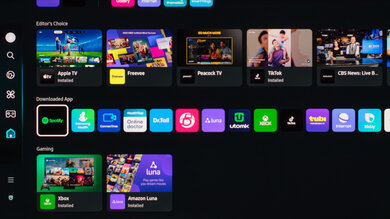
Out of the box most of the popular apps are preinstalled such as Netflix, Youtube and Amazon Video. Many more apps can be downloaded from the sizable Google Play Store.
for pictures & test results

The remote is fairly large and has a dizzying array of buttons, like the remotes of the X930D and X800D. The round arrow button pad is surrounded by a circle of other often used buttons, and serves as the centerpiece of the remote. There is a microphone in the remote for Voice Search, which works well.
Update 12/11/2017: Google Assistant has now been added to Android TV on Sony TVs, and it brings a lot of new features to the voice control: commands like 'open Netflix', 'switch to HDMI 1', 'pause video', 'how's the weather' and 'turn off TV' all work well, though commands to change picture settings like 'set the brightness to 20' and 'switch to Game mode' don't work. The remote score has been increased to reflect the new fuctionality.
for pictures & test results
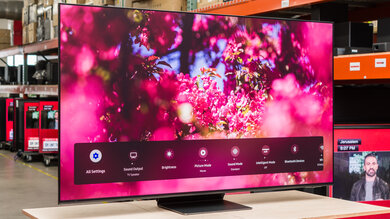
The Android TV remote app has fewer features than the apps of some other smart platforms, but can still be useful.
Update 09/12/2017: Sony has an app called 'Video & TV SideView' that's better than the Android TV app in most ways. It adds a few features like launching both apps and inputs, and has three different remote modes, one being a mouse cursor on the TV. The score and data fields have been updated to reflect the Sony app.
Update 07/11/2018: Sony's Video & TV SideView remote app has been retested on version 5.5.0. The remote app can now stream video files and can only directly launch apps. The data fields have been updated.
Update 10/12/2018: The remote app can directly launch both apps and inputs, even on version 5.5.0; "Apps Only" was a mistake. The value has been corrected to "Both".
for pictures & test results

There are three buttons on the back of the TV that allow changing the channel, volume and input. The center button selects either channel, volume or input while the (+) and (-) buttons increment the setting. The center button also serves as the power button and can power off the TV is it is held down for a few seconds.
for pictures & test results

- Manual
- Batteries
- Remote
- Cable management ties
- RF Blaster