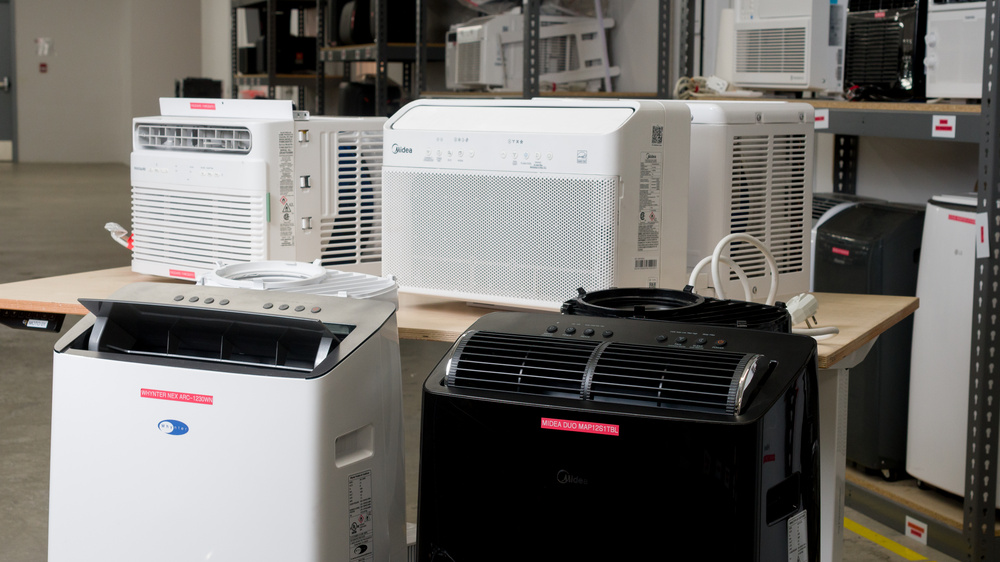
While a standalone A/C unit won't fully replace a central air system, there's no shortage of units on the market that can cool entire apartments and larger living areas. When shopping for a new A/C unit, there are a few things you need to keep in mind, which we've narrowed down using our lab testing and scoring:
- Window vs. portable: Portable A/Cs are easy to install and work where window units aren't practical or permitted. Window units save floor space and are generally more efficient, but require a compatible window and more involved installation.
- Capacity: Match the BTU output to room size: around 5,000 BTU/hr for up to 150 ft², 8,000 for up to 350 ft², and 10,000 for up to 450 ft². Too weak means slow cooling; too strong (on a fixed-speed model) can leave the room cold and clammy.
- Compressor: Inverter compressors adjust output for steadier temperatures, quieter operation, and better efficiency. Fixed-speed models are usually cheaper but cycle on and off to maintain your desired temperature.
- Noise and features: Quiet operation matters most in bedrooms and offices: 60 dBA or higher can be distracting, while 40 dBA or below is generally quiet. Wi-Fi connectivity, smartphone control, and a remote can also make an A/C more convenient to use.
We've bought and tested over 20 air conditioners, and below are our recommendations for the best A/Cs based on those aspects, along with pricing and general availability. If you want a more detailed breakdown of what to look out for, see our buyer's guide at the bottom of this article. We've provided options for window and portable units to give you the best overview of the market. If you're shopping for a specific type of A/C, check out our recommendations for the best portable air conditioners and the best window air conditioners. If you only need an air conditioner for a specific room size, see our recommendations for the best small room air conditioners.

Behind all of our air conditioner recommendations are our product reviews. We buy our own air conditioners directly from major retailers and have our team rigorously test them in our lab. The result? Robust data on features you care about, like cooling capacity and inside noise, which you can then compare across the over 20 models we've tested.
If this sounds cool to you, you'll definitely want to read more in our About Us.
-
Best Air Conditioner
 TypeDual-Hose Portable A/CCompressor TechnologyInverterLarge Room8.0Bedroom/Small Room7.6Combined Efficiency7.7Oversizing Tolerance8.1Advertised Coverage600 ft² (56 m²)Advertised Capacity (DOE)12,000 BTU/hrSee all our test resultsInside Noise8.4
The Whynter NEX ARC-1230WN is the best air conditioner we've tested. Since not every living space can accommodate a window unit, this portable unit earns our top spot for its ease of installation, versatility, and overall cooling performance. Its high cooling capacity makes it a strong choice for larger spaces like basements, open-concept living areas, and playrooms, where it can bring the temperature down relatively quickly. Its inverter compressor also minimizes temperature and humidity fluctuations, so your home should feel consistently cool and dry once it reaches your desired setting. Also, the setup is much simpler than window units, and it blocks less of the window, allowing you to maintain more natural light in your living space.
Other important features are its dual-hose design, which helps it maintain strong cooling performance over longer sessions, while the integrated two-in-one hose keeps the setup tidier than many other dual-hose models. You can operate it using the onboard controls or the included remote, and it also has Wi-Fi connectivity through its companion smartphone app, with support for voice commands through Google Home and Amazon Alexa devices. There are still a few compromises to keep in mind. While its space-saving hose design helps reduce its footprint, it's still liable to be a little too bulky for smaller living spaces. Operating noise is also more of a distraction, especially given that this unit has an inverter compressor that emits a high-pitched chatter, which can be distracting while you're watching TV or listening to music.
-
Best Mid-Range Air Conditioner
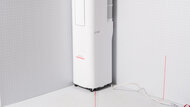
TypeDual-Hose Portable A/CCompressor TechnologyInverterLarge Room7.6Bedroom/Small Room7.3Efficiency7.3Stability7.7Advertised Coverage350 ft² (33 m²)Advertised Capacity (DOE)8,000 BTU/hrSee all our test resultsInside Noise8.5The Hisense Tower HIAP0825TWD is worth a look if you want an air conditioner with a smaller footprint. Its cooling capacity is well-suited to most offices, bedrooms, and medium-sized living areas, while its inverter-controlled compressor helps keep temperature and humidity levels stable during extended use. It also results in quieter overall operation, making it a good fit for noise-sensitive spaces. The tower-like design gives it a more compact footprint than the Whynter NEX ARC-1230WN, which is great in tighter spaces where floor space is at more of a premium. It also has Wi-Fi connectivity, an included remote, and a dedicated dehumidification mode.
There are some performance compromises compared to the pricier Whynter. It'll struggle to keep up in especially large or open-concept spaces. Also, the unit is very tall, which can make stowing it away in colder months a bit of a hassle. Unfortunately, the availability from most retailers is highly region-specific.
-
Best Budget Air Conditioner
TypeSingle-Hose Portable A/CCompressor TechnologyNon-InverterLarge Room5.2Bedroom/Small Room6.3Efficiency4.3Stability7.8Advertised Coverage215 ft² (20 m²)Advertised Capacity (DOE)4,000 BTU/hrSee all our test resultsInside Noise4.4If you're shopping for an A/C on a tight budget and don't mind some big sacrifices to performance and efficiency, the SereneLife SLPAC8 is worth a look. Its compact body and single-hose design make it far more compact than pricier options like the Hisense Tower HIAP0825TWD or Whynter NEX ARC-1230WN, allowing you to fit it in tight spaces far more easily. That said, this smaller size is reflected in its lower overall performance. As tested, it'll take much longer to cool a comparably sized room than the more powerful Hisense. Its single-hose design also forces it to work harder to both bring down the temperature and maintain it; as a result, it's likely to have a similar impact on your utility bill as the more capable Hisense.
Thankfully, it's reasonably well-equipped for a budget-friendly unit. You can operate the unit using the onboard controls or with the included remote control, and it features a dedicated dehumidification-without-cooling mode. That said, there's no Wi-Fi connectivity or associated companion app. It's also very noisy, with its compressor cycling on and off periodically. It also occasionally produces brief bursts of noise exceeding 78 dBA, which is more than loud enough to interrupt a conversation or a TV show.
-
Best Window Air Conditioner
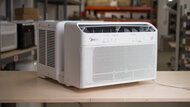
TypeWindow A/CCompressor TechnologyInverterLarge Room8.7Bedroom/Small Room8.3Efficiency8.5Stability8.9Advertised Coverage550 ft² (51 m²)Advertised Capacity (DOE)12,000 BTU/hrSee all our test resultsInside Noise9.0If your living space permits the use of window A/Cs, then we recommend the Midea U-Shaped MAW12V1QWT as our top window pick. This high-end model is highly effective in cooling large spaces like open-concept apartments or large living rooms, thanks to its substantial cooling capacity. It also features an inverter compressor, which can run steadily at a lower speed to maintain your desired temperature rather than cycling on and off like a simpler fixed-speed compressor. This reduces the hit to your power bill in warmer months and keeps your home or apartment consistently cool and dry because it doesn't cycle. It's also particularly quiet while running, so it won't distract you if it's set up near a bedroom or living area, though the unit does emit a high-pitched chatter that's very audible from outdoors; this is normal for inverter compressors.
This air conditioner's U-shaped body allows you to open your window while it's installed, so you can let a breeze in and cool your room without running the machine. That being said, it's still substantially heavier and more cumbersome to install than our top pick, the portable Whynter NEX ARC-1230WN; if you have mobility issues or are concerned about ease of installation, the Whynter is the better option. Otherwise, this A/C unit is Wi-Fi enabled, so you can operate it remotely using a smartphone app or via voice commands with Amazon Alexa or Google Assistant devices. This unit was previously the subject of a stop-sale recall due to potential mold buildup, though Midea has since released a modified variant. If that still gives you pause, the Midea MAW12HV1CWT provides near-identical performance but in a more conventionally shaped package. You won't be able to open your window with the MAW12HV1CWT unit in place, but on the flip side, installation is comparatively easier.
-
Best Budget Window Air Conditioner
TypeWindow A/CCompressor TechnologyNon-InverterLarge Room7.1Bedroom/Small Room7.6Efficiency7.8Stability7.3Advertised Coverage150 ft² (14 m²)Advertised Capacity (DOE)5,000 BTU/hrSee all our test resultsInside Noise7.5If you're looking for a window unit but are on a tight budget, check out the Frigidaire FHWC054TE1. It's considerably less expensive than both the Midea U-Shaped MAW12V1QWT and Friedrich Chill Premier Inverter CCV08A10A, while still providing enough cooling capacity for a typical bedroom or smaller living room. An upside is that this unit's power draw is very low, and it won't have too big an impact on your energy bill in the summer months. Its compressor also cycles rapidly enough in smaller spaces, helping keep humidity levels and temperatures consistent while the unit is running. At under 40 lbs, it's also considerably lighter than either of the window models above, making it more feasible to install yourself.
The trade-off is substantially less cooling capacity than either the Midea or Friedrich, so it'll struggle to cool larger living rooms or open concept spaces in a reasonable amount of time. Unlike the previous models, this unit also lacks Wi-Fi connectivity, but it does have a remote control for operation from a distance. Unfortunately, its white-on-white digital display is hard to read in direct sunlight. Operating noise is quite low, even at the highest fan speed, and won't be a major distraction, even if it's set up in an office or living area. However, it's not as quiet as the Friedrich, and sensitive sleepers might want to turn the fan down if the air conditioner is installed in a smaller bedroom.
-
Best Window Air Conditioner For Bedrooms
TypeWindow A/CCompressor TechnologyInverterLarge Room8.4Bedroom/Small Room8.6Efficiency8.2Stability9.7Advertised Coverage350 ft² (33 m²)Advertised Capacity (DOE)8,000 BTU/hrSee all our test resultsInside Noise9.3For bedrooms, quiet matters just as much as cool, and the Friedrich Chill Premier Inverter CCV08A10A delivers both without much compromise. Its cooling capacity is less than that of the Midea, but it's still well-suited to bedrooms and other smaller spaces, where the inverter compressor can run steadily at a lower speed instead of repeatedly cycling on and off. That steadiness helps it hold exceptionally stable temperature and humidity levels while using relatively little energy. It's remarkably quiet too, even next to other inverter models like the Midea U-Shaped MAW12V1QWT, so it shouldn't do much to interrupt your sleep. A remote control and Wi-Fi connectivity through the FriedrichGo app round things out, letting you adjust the temperature and other settings without getting out of bed.
That said, the Friedrich is fairly bulky and heavy for a window unit with this level of cooling capacity, which can make installation and seasonal storage more of a hassle. Its lower output also means it won't cool especially large or open-concept spaces as quickly as the more powerful Midea. If you're looking for more options to keep your sleeping space comfortable, check out our recommendations for the best air conditioners for bedrooms.













Notable Mentions
-
Midea Duo MAP12S1TBL:
The Midea Duo MAP12S1TBL is mechanically related to the Whynter NEX ARC-1230WN and shares a similar feature suite, but with a lower 10,000 BTU/hr capacity. It's a good alternative if you want to cool a slightly smaller room. That said, it's no more efficient despite its lower capacity.
See our review -
Whynter NEX ARC-1030WN:
The Whynter NEX ARC-1030WN, much like the Midea Duo MAP12S1TBL mentioned above, is mechanically related to the Whynter NEX ARC-1230WN, and also features a lower 10,000 BTU/hr capacity. As with the MAP12S1TBL, it's a good fit for smaller rooms thanks to its fractionally quieter operation, but offers no big gains to either size or efficiency.
See our review -
Hisense AW1422CW1W:
The Hisense AW1422CW1W has even more cooling capacity than the Midea U-Shaped MAW12V1QWT, making it a good option for especially large rooms. However, it's louder, less efficient, and less consistent at maintaining temperature and humidity.
See our review
Recent Updates
Sep 16, 2026:
We replaced the LG LP0721WSR with the SereneLife SLPAC8 as the 'Best Budget Portable Air Conditioner' pick due to current product pricing, and updated the text to reflect our new Test Bench 1.1 methodology.
Aug 13, 2026:
We restructured the article's recommendation lineup, replacing the SereneLife SLPAC8 with the LG LP0721WSR as our budget pick and adding the Friedrich Chill Premier Inverter CCV08A10A as our window pick for bedrooms. We also moved a few previous picks to the Notable Mentions and refreshed the intro with a condensed buyer's guide.
Jun 25, 2026:
We've replaced the LG LP0721WSR with the Hisense Tower HIAP0825TWD as the 'Best Mid-Range Portable Air Conditioner' pick due to the latter's superior overall performance. We've also added the Whynter NEX ARC-1030WN to the Notable Mentions and a Buyer's Guide to help you determine what to look out for when buying a new A/C.
What To Consider When Choosing An A/C
There are a few main factors to consider when shopping for a new A/C unit. Here are some of the key considerations to take into account:
A/C Design
We buy and test both window-mounted and portable units, which each have their own strengths and weaknesses:
-
Portable Units
- They can be moved and installed relatively easily.
- They take up a lot of room, especially dual-hose units, which can be an issue in rooms where a lot of real estate is occupied by a desk, bed, or dresser.
- They're less efficient than window units due to the added heat from the compressor, located inside the room that's being cooled, which needs to be offset.
- Single-hose models are less efficient and less effective than dual-hose models, as the former intake indoor air to cool the compressor, while dual-hose models intake outdoor air.
-
Window Units
- They're not permitted in all residences and might not fit all windows.
- If allowed, they take up far less space than portable units, with the bulk of the unit hanging outside your window, making them a more space-efficient option for smaller rooms.
- They're more efficient than portable units, as there's no need to offset compressor waste heat.
- Seasonal installation and removal can be a hassle, especially for larger, heavier high-capacity units.
Compressor Type
Compressor technology falls into one of two categories for household A/Cs: inverter and fixed-speed compressors.
-
Inverter Compressors
- Generally found on more expensive models.
- Can run consistently at a lower speed to maintain a desired temperature, instead of cycling on and off.
- This results in greater flexibility and allows the A/C to run efficiently in areas where it would otherwise be oversized, as the unit can cool as quickly as it dehumidifies, keeping rooms comfortably cool instead of clammy.
- Introduces a higher number of potential failure points.
-
Fixed-Speed Compressors
- Relatively inefficient and can result in inconsistent temperature and humidity levels since this style of compressor cycles on and off to maintain your desired temperature.
- Typically found on cheaper units.
- Lack of an inverter control board reduces potential failure points.
Capacity
If you choose an air conditioner with a fixed-speed compressor, you'll want to pay close attention to its overall capacity. This is because fixed-speed compressors operate as their name suggests: they either run at full speed or not at all. If you purchase an A/C with too much capacity for a given space, it will cool a room faster than it can dehumidify it, rendering the space cold and clammy. Below is a quick outline of the cooling capacity you should aim for, depending on the size of the room you're trying to cool.
-
5,000 BTU/hr
- Generally suitable for rooms up to 150 ft² (13.9 m²)
-
8,000 BTU/hr
- Generally suitable for rooms up to 350 ft² (32.5 m²)
-
10,000 BTU/hr
- Generally suitable for rooms up to 450 ft² (41.8 m²)
Once the desired temperature is reached, fixed-speed compressors must cycle on and off to maintain the setpoint. With an oversized unit, the compressor cycling can be slow to cycle back on. This gives time for both temperature and humidity to creep back up, which can cause the air in your room to feel periodically cold and clammy at times.
This issue doesn't affect A/Cs with inverter compressors nearly as much, as they can lower their compressor speed to match the required load. That said, there is a point of diminishing efficiency here: a 15,000 BTU/hr inverter unit used in a small space and forced to operate constantly at its lowest operating range simply won't be as efficient as a 5,000 BTU/hr inverter unit that's a better match for the space.
Noise
Here are a couple of examples of different noise levels that cover the vast majority of household A/Cs, and what they can generally be compared to:
- ≥ 60 dBA
- Generally, the threshold most people would consider to be "noisy" or "distracting" for a household appliance. Examples include conversation spoken at a normal volume or typing on an office keyboard.
- 50 dBA
- Within the general range of quiet conversation or moderate to strong rainfall.
- 40 dBA and below
- What people typically consider "quiet." Examples include the range of most household appliances, like a refrigerator or dishwasher.
Volume aside, you should also consider how the A/C design and compressor type factor in. Portable A/Cs have their compressors inside the space you're trying to cool, so you're more likely to hear them while you're working in an office or trying to get some sleep in your bedroom. Conversely, window A/C compressors are located outside your home, isolating you from most of their noise.
Inverter compressors tend to produce a high-pitched chattering sound when entering a cooling cycle, which is a relatively infrequent, but sometimes distracting. Conversely, fixed-speed compressors regularly cycle on and off to maintain your desired temperature, resulting in a more frequent, but potentially less noisy, sound overall.
All Reviews
The recommendations above are among the best AC units for most people. We factor in price, visitor feedback, and availability.
That said, there's no single best option that'll suit everybody; your needs will depend on your budget, the size of the space you're trying to cool, your tolerance for operating noise, and whether you like having a device with convenience features like Wi-Fi connectivity. If you'd like to choose for yourself, here's the list of all our A/C reviews.