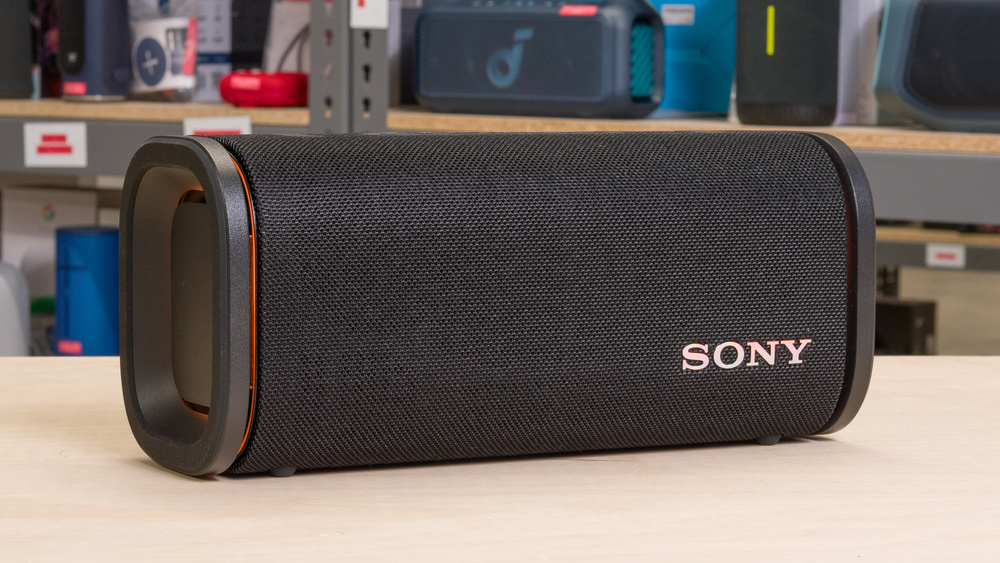
The Sony ULT FIELD 5 is a portable Bluetooth speaker from the ULT Power Sound series. Its feature set includes ULT preset modes that inject bassier EQ tunings, room correction, and a suite of codecs like LDAC for higher resolution audio. It's wrapped in a mesh fabric with a sturdy plastic frame and two passive bass radiators. It comes with a carrying strap to take it with you, and its 'Stamina' setting helps extend its battery life to keep the party going through the night. Unlike its smaller sibling, the Sony ULT FIELD 3, it's a stereo speaker, so your music isn't downmixed. It's poolside-ready with the IP67 rating to protect it from dust and water, and it'll float.
Our Verdict
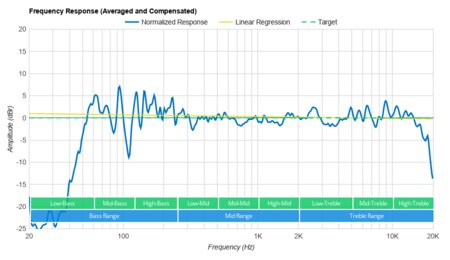
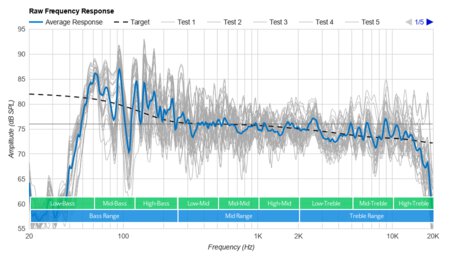
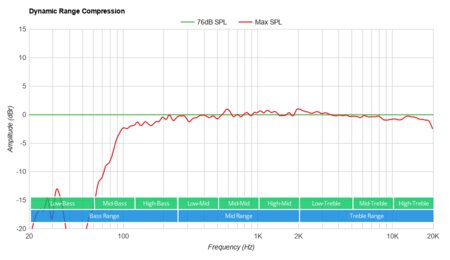
The Sony ULT FIELD 5 is decent for listening to music. Its tuning offers a good amount of boom to kick drums, a slightly scooped mid-range, and an exciting treble response. You can choose between two ULT modes to up the low-end response, or create a custom EQ setting. That said, it can't overcome physics; the speaker can't deliver deep bass frequencies with much rumble, which is expected for a product of this size. While the speaker features room correction, we didn't find it made a difference, but your experience can vary in different circumstances. The speaker is stereo, and it gets plenty loud, but there's compression present in the bass frequencies at max volume. Otherwise, you get the option of LDAC Bluetooth codec or a wired connection for high-quality audio playback. The intuitive controls and competent app offer you room for customization or pairing additional compatible speakers.
Gets pretty loud.
Customizable sound settings.
LDAC codec and wired connectivity.
Sensitive to positioning.
Bass compression at max volume.
Soundstage isn't very wide and immersive.
The Sony ULT FIELD 5 is acceptable for watching videos and movies. While it's a stereo speaker, it doesn't have a wide soundstage, and at max volume, it compresses bass frequencies. That said, it gets fairly loud, and you can customize its somewhat excited tuning, which isn't ideal for speech, via the EQ or sound presets. Although the speaker features room correction, we didn't find notable differences, but this can depend on your space. Bluetooth latency is quite low, so you shouldn't experience A/V sync issues, but if you do, there's always an analog connection available.
Gets pretty loud.
Low latency audio.
Customizable sound settings.
Sensitive to positioning.
Bass compression at max volume.
Soundstage isn't very wide and immersive.
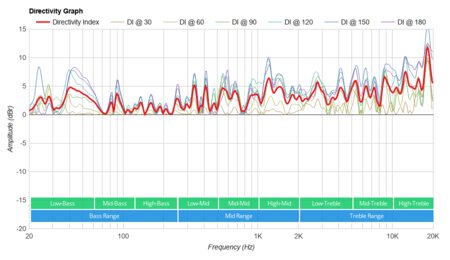
The Sony ULT FIELD 5 is good for podcast listening. It's very portable, so you can move it from room to room. The speaker's max volume is loud enough to compete with activities in the background, like cooking or cleaning your home. Voices come through clearly, and if they don't, you can adjust the 10-band EQ. You can connect the speaker to two devices simultaneously, so it's easy to switch from your laptop to your smartphone for playback. On the downside, the speaker is sensitive to listening angles, which means that if you move around a lot, the audio's clarity diminishes when you don't face the speaker. Thanks to 'Stamina' mode, you can extend the battery life from 13.3 hours to an impressive 68 hours, so you can go a few days without a recharge if you find the tuning works just fine for voices on podcasts.
Gets pretty loud.
Customizable sound settings.
Sensitive to positioning.
The Sony ULT FIELD 5 doesn't have a microphone to support a voice assistant.
The Sony ULT FIELD 5 is very good for outdoor use. It's very portable with a carrying strap and a solid build with an IP67 rating against dust and water exposure. It'll even float if it falls into a pool. Its battery lasts for over 13 hours or over 68 hours (with 'Stamina' mode), and you can use its USB-C port to charge your devices in a pinch. The speaker gets loud, plays back your audio in stereo, though it's sensitive to positioning, so you'll want to aim it where you're located, and at max volume, it compresses bass frequencies. Its tuning tends to favor extra boom in the high-bass and a bright treble, and you can adjust it with different preset modes, with the 10-band EQ, and use room correction (though we didn't find room correction did much to change the sound). If you have a compatible speaker, you can use it in stereo pairing mode or 'Party Connect' mode.
Gets pretty loud.
Customizable sound settings.
IP67-rated and it floats.
Sensitive to positioning.
Bass compression at max volume.
Check Price
Differences Between Sizes And Variants
The Sony ULT FIELD 5 has a couple of other names, including the Sony SRS-ULT50 and Sony YY7859E, and we expect these to perform the same as our unit. It comes in 'Black' and 'Off-White'; you can see the label for our 'Black' unit.
If you encounter a variant or additional colorways, please let us know in the comments, and we'll update the review.
Popular Speaker Comparisons
The Sony ULT FIELD 5 is the successor to the Sony SRS-XG300. Besides cosmetic differences and the extra heft on the ULT FIELD 5, the biggest changes are to the tuning, and it's a bit louder than the predecessor. The ULT FIELD 5 has a brighter top-end and a broadly more excited sound, but with that said, the SRS-XG300 has EQ too. The last generation speaker also has some voice assistant features, albeit limited. If you own the old model, you don't necessarily need to grab the latest, unless the new look or bassier tuning compels you. Unlike the smaller Sony ULT FIELD 3, the ULT FIELD 5 is a stereo speaker, so you won't deal with downmixed mono audio. Sizing up to the Sony ULT FIELD 7 opens up more wired connectivity, including a mic input if you're into karaoke sessions, and it's louder than the ULT FIELD 5, which has a slightly longer battery life. Casting a wider net to other brands, the JBL Xtreme 4 is a lighter-weight option with more than double the ULT FIELD 5's battery life, a similar maximum output volume, and a competent app. Notable differences that may tilt one or the other in your favor include the flatter, brighter tuning on the JBL when compared to a heavier bass on the ULT FIELD 5. The JBL lacks the AUX port available on the ULT FIELD 5, so if you want a wired connection, the ULT FIELD 5 prevails.
For more options, consider the best portable Bluetooth speakers, the best outdoor speakers, and the best Bluetooth speakers for bass.
For most people the JBL Xtreme 4 beats out the Sony ULT FIELD 5, but it may depend on quality of life differences. The JBL manages to nearly double the battery life of the Sony, and yet, it weighs noticeably less at 2.1 kg (4.7 lbs), compared to the Sony at 3.3 kg (7.3 lbs). Despite the lighter weight, both reach comparable max output volumes, and build quality is similar: both are rated IP67 against dust and water. You can tweak the tuning on either using the EQ in-app, with the JBL sounding a bit weaker in the bass (by default), but more even in the mids, while the Sony boosts high-bass and treble for a more excited sound. The Sony has lower latency, and it supports LDAC for higher-quality audio streaming, and it has RGB lighting, which you might like. Its 'Stamina' mode disables tuning features and extends the battery life considerably. It'll also float, unlike the JBL.
The Bose SoundLink Max is a lighter weight speaker than the Sony ULT FIELD 5, with an integrated handle, compared to the Sony's removable strap. Which speaker is better depends on your preferences. Both are well-built with IP67 ratings. The Bose is primarily coated in silicone, while the Sony is wrapped in a durable mesh. Only the Sony will float, though. The controls on the Bose are more comprehensive, and there's support for voice assistants. The Bose has a more balanced default tuning than the Sony, but you can EQ either. The Sony has a more involved 10-band EQ, and lower Bluetooth latency, alongside support for LDAC for higher-quality streaming. While the Bose has a longer battery life, the Sony's 'Stamina' mode can extend the battery life much longer than the Bose.
The Sony ULT FIELD 5 is the successor of the Sony SRS-XG300, and they have a lot in common. The main differences have to do with the ULT FIELD 5 adding ULT SOUND presets that make it a bassier proposition. While the SRS-XG300 compresses less at max volume, it has some support for voice assistants, which is absent on the ULT FIELD 5. There are compelling reasons to pick up either, but if you like a bassier sound, then the ULT FIELD 5 is probably the better pick.
Choosing between the Sony ULT FIELD 5 and the Sony ULT FIELD 3 depends on how much you value portability. While there are pros and cons to both speakers, the main appeal of the ULT FIELD 3 is its smaller size, similarly long battery life, and balanced frequency response. On the other hand, it comes with compromises, because out of the two, only the ULT FIELD 5 works in stereo, and it can get much louder with a better soundstage and less compression. Otherwise, both are well-built with IP67 ratings, and they use the same app.
Test Results
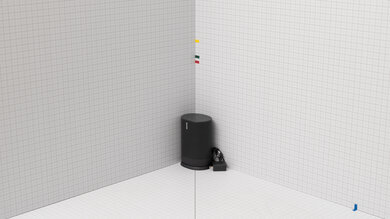
for pictures & test results
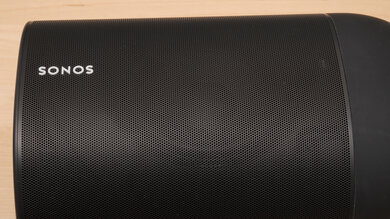
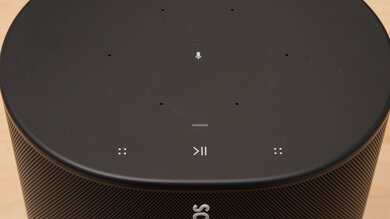
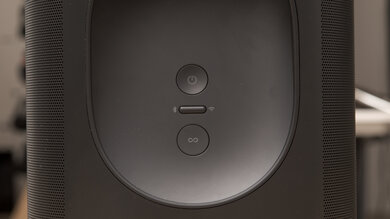
for pictures & test results

for pictures & test results