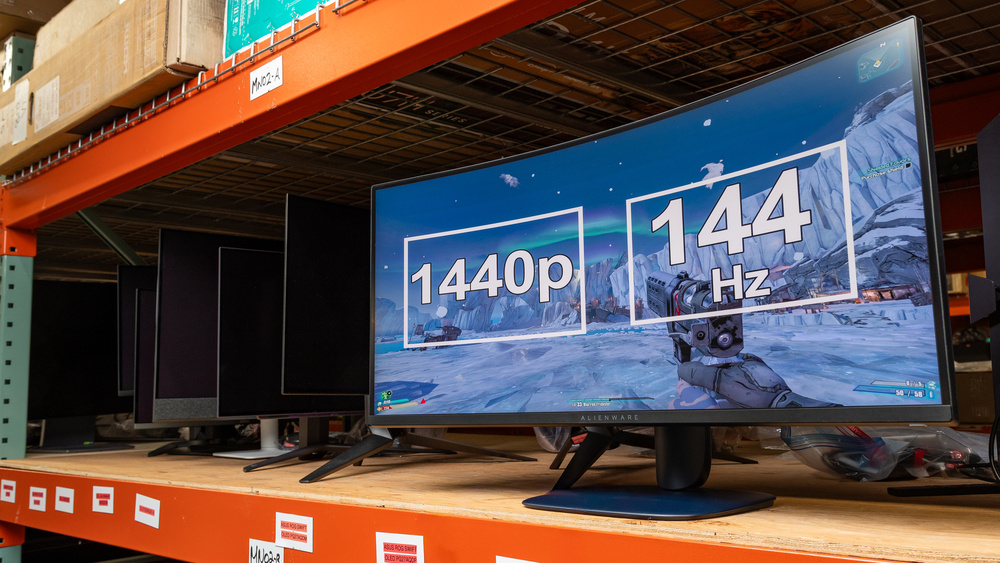
1440p 144Hz monitors combine a decent refresh rate with a high enough resolution to see details in your games. As they don't offer the fastest refresh rates or the highest resolution, they can be good choices for gaming with entry-level PCs. Keep in mind that monitors are becoming equipped with higher refresh rates, so 1440p displays with a native refresh rate of exactly 144Hz are less common. Because of this, you can find a wider range of options if you look for something with a slightly higher refresh rate, even up to 280Hz, and use them at 144Hz. The recommended monitors below reflect that. You can also look for 4k @ 144Hz monitors, but those require a more powerful graphics card to run at a higher resolution.
There are a few factors to think about when looking for a gaming monitor. It's important to consider the monitor's response time if you want something with good motion handling. Low input lag is also beneficial, but most monitors already have it anyway. Besides that, most of these models offer gaming features, like support for all common VRR formats to reduce screen tearing.
We've bought and tested over 400 monitors, and below are our picks for the best 1440p gaming monitors with native refresh rates up to 180Hz. Check out our recommendations for the best 1440p gaming monitors, the best 144Hz monitors, and the best 1440p monitors.
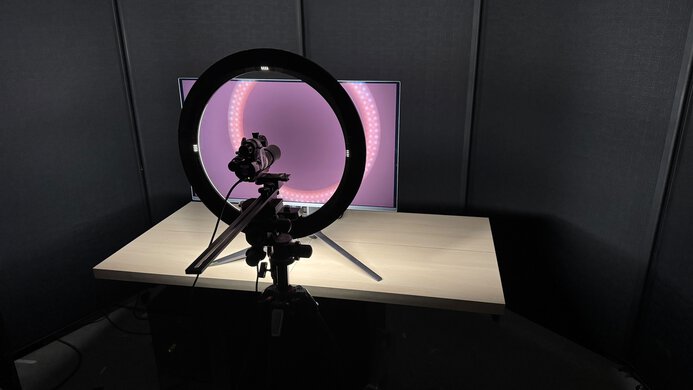
We buy and test more than 30 monitors each year, all of which we purchase ourselves, without cherry-picked units or samples. We put a lot into each unbiased, straight-to-the-point review, and there's a whole process from purchasing to publishing, involving multiple teams and people. We do more than just use the monitor for a week; we use specialized, custom tools to measure various aspects and deliver objective, data-driven results. We also consider multiple factors before making any recommendations, including the monitor's cost, its performance compared to the competition, and whether it's easy to find.
-
Best 1440p 144Hz Monitor
 PC GamingResponse TimeHDR PictureSDR PictureBrightnessSize34"Panel TypeOLEDSub-TypeQD-OLEDMax Refresh Rate280 HzNative Refresh RateHzSee all our test resultsNative Resolution3440 x 1440
The best 1440p 144Hz monitor we've tested is the ultrawide Dell Alienware AW3426DW. It's a native 280Hz monitor that performs well at 144Hz. It has a native 3440x1440 ultrawide resolution and, combined with its 34-inch screen, provides more screen real estate than a 1440p monitor with a 16:9 aspect ratio. It's outstanding for PC gaming, with near-instantaneous response time at any refresh rate, including at 144Hz, and virtually no motion blur. Additionally, it supports all common VRR formats to reduce screen tearing, and it has HDMI 2.1 bandwidth to take advantage of HDMI 2.1 graphics cards.
Besides its fantastic gaming performance, this monitor also boasts superb picture quality thanks to its QD-OLED panel. It displays deep blacks in a dark room, and small highlights are bright enough to stand out. Additionally, colors appear very vivid, providing a remarkable HDR experience. However, it's worse for bright rooms because it doesn't get bright enough to fight intense glare, and its black levels rise, making them look gray. You may want to consider the LG 34GS95QE-B if you want a WOLED with deeper blacks in bright rooms, but it sometimes costs more than the Dell.
-
Best Mid-Range 1440p 144Hz Monitor
PC GamingResponse TimeHDR PictureSDR PictureBrightnessSize27"Panel TypeOLEDSub-TypeQD-OLEDMax Refresh Rate240 HzNative Refresh RateHzSee all our test resultsNative Resolution2560 x 1440If you find the Dell Alienware AW3426DW too expensive, you can save money and still get great performance with the HyperX OMEN OLED 27q. The main difference is that it has a smaller 27-inch screen than the Dell, so it doesn't offer the same immersive gaming experience. That said, it's very similar to the Dell in terms of gaming performance because it's another 1440p option with a high refresh rate that performs very well at 144Hz. It has incredibly sharp motion, low input lag for a responsive feel, and support for all common VRR formats. Plus, like the Dell, it has HDMI 2.1 bandwidth that's useful if you have an HDMI 2.1 graphics card.
Even its picture quality is similar to that of the Dell because it also has a QD-OLED panel. This means it displays the same deep blacks in dark rooms without any haloing around bright objects. It doesn't get as bright as the Dell, though, so highlights don't pop as much, and colors aren't vivid. You can check out the LG 27GX704A-B if you want a 240Hz OLED that gets brighter, but it tends to cost more than the HyperX.
-
Best Budget 1440p 144Hz Monitor
PC GamingResponse TimeHDR PictureSDR PictureBrightnessSize27"Panel TypeLCDSub-TypeVAMax Refresh Rate180 HzNative Refresh RateHzSee all our test resultsNative Resolution2560 x 1440If you're looking for the best budget 1440p 144Hz monitor, the AOC Q27G3XMN is a great choice that offers good value. It differs from the HyperX OMEN OLED 27q because it lacks a QD-OLED panel, so it doesn't offer the same deep, inky blacks and vivid colors. That said, it uses Mini LED backlighting and offers good local dimming, which improves picture quality in dark scenes, though there's some haloing around bright objects against dark backgrounds. Plus, it gets much brighter than the HyperX, making it a fantastic choice for gaming in well-lit rooms.
While it has a max refresh rate of 180Hz, you can only get this over DisplayPort, as it supports a max of 144Hz over HDMI anyway. It has a fast response time for good motion handling, but it's worse overall than the HyperX and has black smearing in dark scenes. If this doesn't bother you, you can also check out the similar AOC Q27G40XMN. It has better local dimming than the Q27G3XMN, but motion looks worse, and it's only available in the US.
-
Best Cheap 1440p 144Hz Monitor
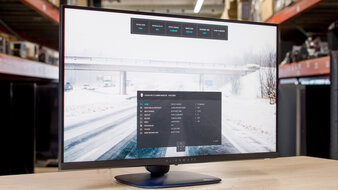
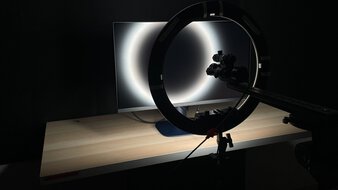
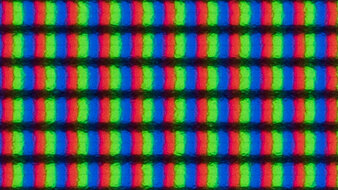
PC GamingResponse TimeHDR PictureSDR PictureBrightnessSize27"Panel TypeLCDSub-TypeIPSMax Refresh Rate180 HzNative Refresh RateHzSee all our test resultsNative Resolution2560 x 1440If you want a simple, cheap 1440p 144Hz monitor, check out the Dell Alienware AW2725DM. It features the same 27-inch screen size and 16:9 aspect ratio as the AOC Q27G3XMN, but it falls short in picture quality. It doesn't use Mini LED backlighting and has terrible local dimming that automatically turns on in HDR and can't be turned off. Combining its haloing around bright objects with its low contrast ratio means blacks appear gray, and highlights fail to stand out for an impactful HDR experience. However, this is what you have to expect at this price point.
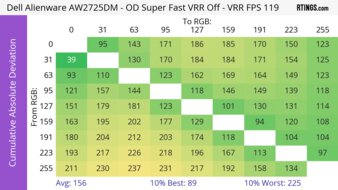
Despite its worse picture quality, it's better for pure gaming than the AOC in a few ways. It has less black smearing with fast-moving objects, but there's still blur in action content. Like the other recommended monitors, it has a slightly higher refresh rate than 144Hz, and it still works well at this refresh rate. It also supports all common VRR formats, but one downside is that motion looks worse with VRR enabled than without it.





Notable Mentions
-
Dell Alienware AW3425DW:
The Dell Alienware AW3425DW is an older ultrawide QD-OLED that shares many features with the Dell Alienware AW3426DW. However, the AW3425DW uses an older panel that isn't as bright and has worse black level raise in bright rooms, where blacks look purple.
See our review -
LG 27GX700A-B:
The LG 27GX700A-B is a high-end OLED that's a smaller, 27-inch alternative to the Dell Alienware AW3426DW. The LG usually costs less as well, but it has less vivid colors and worse text clarity.
See our review -
Dell Alienware AW2726DM:
The Dell Alienware AW2726DM is a 1440p, 240Hz OLED that competes with the HyperX OMEN OLED 27q and performs similarly. It's worth considering if you're on a tight budget, but it doesn't get as bright and lacks HDMI 2.1 bandwidth.
See our review -
ASUS ROG Strix XG27ACS:
The ASUS ROG Strix XG27ACS is a cheap gaming monitor that competes with the Dell Alienware AW2725DM. The ASUS performs similarly for the most part, but it has better motion handling with VRR enabled. However, the ASUS has a smaller USB hub.
See our review
Recent Updates
Aug 10, 2026:
We replaced the Dell Alienware AW3425DW with the newer and brighter Dell Alienware AW3426DW. In the Notable Mentions, we removed the Dell Alienware AW3225DM, and we added the LG 27GX700A-B and the AW3425DW to better represent the current market.
May 15, 2026:
We started recommending 1440p, 240Hz monitors because 1440p, 144Hz monitors are hard to find. As such, we replaced the Dell Alienware AW3423DWF and the Dell Alienware AW3425DWM with the Dell Alienware AW3425DW and the HyperX OMEN OLED 27q, respectively, because they're better overall. In the Notable Mentions, we removed the MSI G274QPF-QD and added the Dell Alienware AW2726DM.
Feb 20, 2026:
We renamed the Dell Alienware AW3425DWM to the 'Best Mid-Range 1440p 144Hz Monitor' to better reflect its market position. We also replaced the MSI G274QPF-QD with the Dell Alienware AW2725DM, which has better motion handling. We added the G274QPF-QD to the Notable Mentions.
Dec 04, 2025:
We added the MSI G274QPF-QD as the 'Best Cheap 1440p 144Hz Monitor' to provide an alternative option and maintain consistency with other recommendations. We also added the Dell Alienware AW3225DM to the Notable Mentions.
Jul 07, 2025:
We replaced the Dell S3422DWG with the Dell Alienware AW3425DWM, as it has better performance. We also mentioned the AOC Q27G40XMN in the 'Best Budget' pick.
All Reviews
Our recommendations are based on what we think are the best 1440p monitors with refresh rates up to 280Hz currently available in the United States. They're adapted to be valid for most people in each price range. The rating is based on our review, visitor feedback, and price. For example, two monitors may perform the same, but the cheaper one will be recommended. We also consider availability, as we don't recommend a monitor that's hard to find.
If you'd prefer to make your own decision, here's the list of all of the 1440p monitors that we've tested with a refresh rate of up to 240Hz. Be careful not to get too caught up in the details. Most monitors are good enough to please most people, and the things we fault monitors on are often not noticeable unless you really look for them.