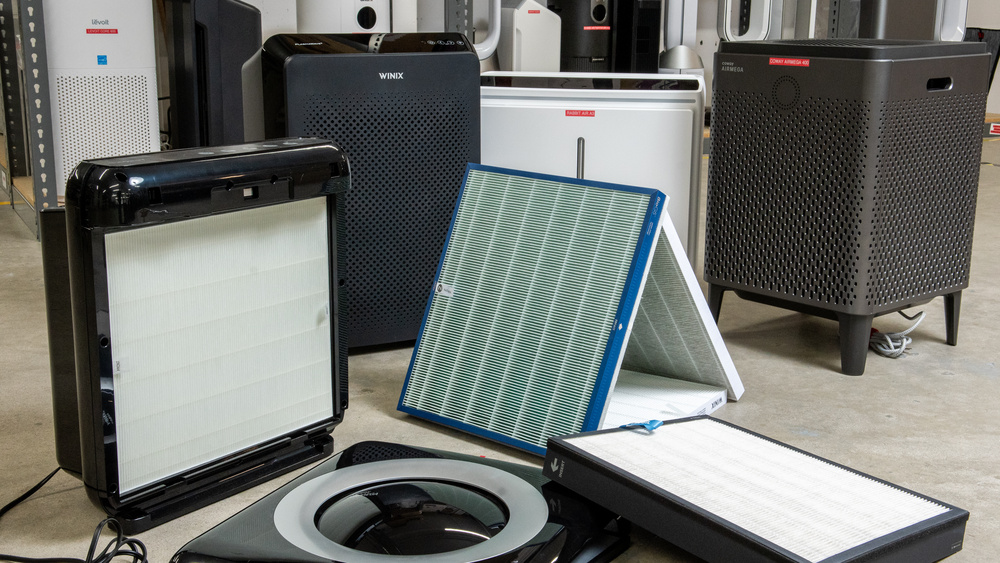
HEPA (High Efficiency Particulate Air) filtration is a term coined by the U.S. Department of Energy and is strictly defined. A filter that meets the HEPA standard should trap 99.97% of airborne particles 0.3 microns (µm) in size. Unfortunately, as the household air purifier market has grown, manufacturers have coined marketing terms like 'HEPA-like' or 'HEPA-type' that aren't subject to the same level of regulatory scrutiny. Others simply don't disclose the results of any independent lab testing that would confirm a HEPA rating. As a result, if you're dead-set on buying an air purifier that meets this standard, it can be somewhat difficult to cut through all the marketing fluff.
To help you separate fact from marketing, we independently verify manufacturer's claims and identify which models actually use filter systems that meet the HEPA standard. Of course, HEPA certification doesn't necessarily guarantee good overall performance; an air purifier's clean air delivery rate (CADR), placement in your room, filter composition, and, in the case of smaller units, how many units you buy, are just as important in dictating how clean the air in your home will be. You can find out more in the buyer's guide at the bottom of this article.
We've bought and tested over 50 air purifiers, and below are our recommendations for the best air purifiers with HEPA filters that you can buy. For more general recommendations, see our picks for the best air purifiers for allergies, the best air purifiers for pets, and the best air purifiers for basements. Alternatively, if you're looking for a vacuum with HEPA-level filtration, you can check out our recommendations for the best HEPA vacuums and the best vacuums for allergies.
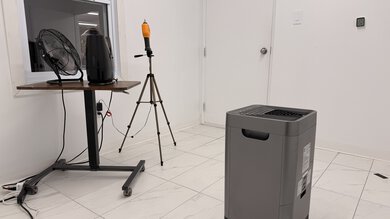
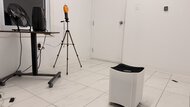
We buy and independently test air purifiers with no manufacturer samples, sponsorships, or pre-approved talking points. Each unit goes through the same standardized test bench, and the results are validated by multiple teams before being published on our website, so you can accurately compare them side by side.
This is all supported by readers like you, through paid memberships and your purchases through our links.
-
Best HEPA Filter Air Purifier For Most People
 HEPA CertifiedYesParticle Filtration Rate7.9Filtration Layers3 StageMeasured PM1.0 CADR403 m³/hr (237 CFM)Recommended Room Size @ Max Fan Speed34.4 m² (370 ft²)Measured PM1.0 CADR280 m³/hr (165 CFM)See all our test resultsRecommended Room Size23.9 m² (257 ft²)
The best HEPA filter air purifier we've tested for most people is the Coway Airmega Mighty2. It's a relatively simple unit, but it delivers where it counts: its main filter provides strong single-pass filtration performance against pollen, pet dander, mold, and bacteria. Real-world performance is also strong, with sufficient clean-air delivery to effectively handle spaces such as living rooms, larger bedrooms, and kitchens. Its air quality sensor can also automatically adjust the fan speed based on current particle levels.
The main compromises are its simpler feature set and somewhat bulky design. It lacks smartphone connectivity or remote operation, unlike some similarly priced options, and its rectangular form factor can be a little harder to fit into tighter spaces. On the upside, it's very quiet overall, almost inaudible at its lowest fan speed and quieter than most peers at its highest.
-
Best High-End HEPA Filter Air Purifier
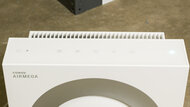
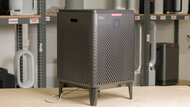
HEPA CertifiedYesParticle Filtration Rate8.9Filtration Layers3 StageMeasured PM1.0 CADR625 m³/hr (368 CFM)Recommended Room Size @ Max Fan Speed53.4 m² (575 ft²)Measured PM1.0 CADR198 m³/hr (117 CFM)See all our test resultsRecommended Room Size16.9 m² (182 ft²)For the best overall HEPA filtration performance regardless of price, the Coway Airmega 400 is our top pick thanks to its combination of HEPA-certified filtration and high clean air delivery rate. Compared to the cheaper and smaller Coway Airmega Mighty2, the Coway will deliver the same level of air quality in less time, with sufficient performance in its highest fan speed setting for open-concept living areas, partial basements, or some apartments. The HEPA-grade primary filter in its two-stage filtration system won't have trouble trapping mold, pollen, or pet dander. The other half of that primary filter is a pellet-type activated carbon layer to minimize odors, though, as with most household units, there isn't really enough activated carbon in that layer to have a meaningful effect. More important than its filter certification or composition is its overall performance.
Unusually for a high-end unit like this, there's no Wi-Fi connectivity or an associated smartphone app, so you can't track air quality or make adjustments to settings while you're away from home. Of course, whether that's a downside depends on your feelings about connecting an appliance to your phone, whether because of data privacy concerns or simply because you don't want to go through the hassle of setting up a new device on your home network. Additionally, this unit has an air quality sensor that automatically adjusts its fan speed based on real-time particle levels. Operating noise is relatively low, with its low-speed fan setting being almost inaudible. The one significant downside of this unit is its bulky footprint, which can make it hard to fit in tighter areas.
-
Best Mid-Range HEPA Filter Air Purifier
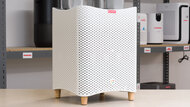
HEPA CertifiedYesParticle Filtration Rate7.9Filtration Layers1 StageMeasured PM1.0 CADR391 m³/hr (230 CFM)Recommended Room Size @ Max Fan Speed33.4 m² (360 ft²)Measured PM1.0 CADR214 m³/hr (126 CFM)See all our test resultsRecommended Room Size18.3 m² (197 ft²)The Mila Air 3 is a great option if you want an air purifier with HEPA-certified filtration that's a little more compact and a little easier to place in tight spots. The unit's total size is nearly half that of the Coway Airmega 400, making it far easier to set up on a desk, dresser, or table. Not only that, it features a unique swappable filter system and is available with a number of filter options tailored for different airborne particles, most of which are HEPA-certified: our test unit was fitted with the 'The Big Sneeze' filter, which is optimized for trapping pollen and other outdoor pollutants. A higher-grade 'Overreactor' filter is available, though it's likely that this higher-density filter could negatively impact performance: while a higher-density filter can, in theory, do a better job of trapping airborne particles in a single pass, it'll also reduce the amount of air that can actually flow through the unit and result in an inferior clean air delivery rate.
In terms of performance, its relatively small size comes with compromises: the Mila has a lower-wattage motor and less filter surface area than the larger Coway. That's clearly evident in performance: at their highest fan speed, the Coway is much faster than the Mila in providing the same level of air quality within an equivalently sized space. Unlike the Coway, the Mila features a smartphone companion app, so you can monitor your room's air quality or adjust settings while you're away from home. You might have some trouble finding this unit at major retailers, though you can order it directly through Mila's website.
-
Best Budget HEPA Filter Air Purifier
HEPA CertifiedYesParticle Filtration Rate7.2Filtration Layers3 StageMeasured PM1.0 CADR278 m³/hr (163 CFM)Recommended Room Size @ Max Fan Speed23.7 m² (255 ft²)Measured PM1.0 CADR144 m³/hr (85 CFM)See all our test resultsRecommended Room Size12.3 m² (132 ft²)The Dreo Air Purifier 539S is a good option if you want to spend less while still getting useful air-cleaning performance and a full set of convenience features. It delivers enough airflow for smaller living rooms, large bedrooms, and home offices. It also runs very quietly at its lowest fan speed, making it easy to keep nearby while sleeping or working. Its feature set is especially generous compared to the pricier Coway picks, offering Wi-Fi connectivity, automatic fan adjustment, air quality monitoring, operating schedules, and app controls.
The biggest trade-off is overall cleaning performance. The larger Coway Airmega Mighty2 has a considerably higher clean air delivery rate, so it cleans the air faster and handles larger rooms more effectively, while the Mila Air 3 also offers broader room coverage. The Dreo loses more performance at quieter fan speeds, too, so you'll need to turn it up in larger rooms or when particle levels rise quickly.
-
Best Compact HEPA Filter Air Purifier
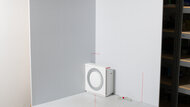
HEPA CertifiedYesParticle Filtration Rate6.2Filtration Layers4 StageMeasured PM1.0 CADR166 m³/hr (98 CFM)Recommended Room Size @ Max Fan Speed14.2 m² (153 ft²)Measured PM1.0 CADR100 m³/hr (59 CFM)See all our test resultsRecommended Room Size8.6 m² (92 ft²)The Shark NeverChange HP152 is worth considering if a small footprint is a main priority when shopping for a HEPA air purifier. Even compared to the modestly sized Mila Air 3, the Shark is comfortably smaller and about half the weight, making it a good option for areas where space is at a premium; you can even keep it on a desk or table without it monopolizing your attention. This unit features a HEPA-rated filter with an activated carbon sheet intended to reduce odors, though the actual amount of activated carbon is pretty minimal and unlikely to have much impact. Unfortunately, performance is where this unit's compromises are most felt: even at its highest fan speed, it's only really suitable for use in smaller spaces like bedrooms or offices. The aforementioned Mila can provide the same level of air quality in under half the time.
While this unit lacks Wi-Fi connectivity and an associated smartphone app, it does have an air quality monitoring system that automatically adjusts its fan speed, so you won't have to babysit it while it runs. Operating noise is decently low; it's louder than the Mila or Coway Airmega 400 at its lowest fan speed, though it still shouldn't be overly disruptive in that configuration. That said, it's significantly quieter than either at its maximum fan speed, which is good if you're able to set it up relatively far away.
Notable Mentions
-
Dyson Purifier Big+Quiet Formaldehyde BP04:
The Dyson Purifier Big+Quiet Formaldehyde BP04 is a high-end air purifier that runs quietly, but it has a lower CADR than the Coway Airmega 400 and takes up more room.
See our review -
Honeywell HPA300:
The Honeywell HPA300 is a good alternative to the Coway Airmega Mighty2 if you want something with more room coverage and don't mind its higher operating noise and larger size.
See our review -
Coway Airmega Mighty AP-1512HH:
The Coway Airmega AP-1512HH Mighty is the predecessor to the Coway Airmega Mighty2; while it offers a similar max CADR, it doesn't do as well at lower, quieter fan speeds.
See our review -
Coway Airmega 200M:
The Coway Airmega 200M is a good alternative to the Coway Airmega Mighty2, as it's typically sold at a lower price. That said, while its max CADR is similar to the newer Mighty2, it doesn't do as well at lower, quieter fan speeds.
See our review -
Shark BreatheClear MAX HP365CO:
The Shark BreatheClear MAX HP365CO is a HEPA-certified alternative with good particle filtration and room coverage. However, the Coway Airmega Mighty2 delivers better overall air-cleaning performance.
See our review
Recent Updates
Sep 30, 2026:
We've replaced the Coway Airmega 200M with the Coway Airmega Mighty 2 as the new 'Best HEPA Filter Air Purifier For Most People' pick, and moved the Coway Airmega 200M to the Notable Mentions section of the article.
Aug 20, 2026:
We added the Coway Airmega 200M as our new 'Best For Most People' pick category, added the Dreo Air Purifier 539S as our budget pick, and added the Shark BreatheClear MAX HP365CO as a Notable Mention.
Things To Keep In Mind When Buying A HEPA Air Purifier
Filtration Grades
Even within the realm of HEPA-certified filters, there are a few different categories, each of which is meant to align with a different usage.
- True HEPA: The baseline for HEPA certification. True HEPA filters are certified to trap 99.97% of airborne particles 0.3 microns (µm) in size.
- H13: Effectively one level up from True HEPA filtration, and typically found in healthcare environments. H13-grade filters are rated to trap 99.95% of particles 0.2 microns (µm) in size.
- H14: Usually found in medical environments with very strict air quality requirements, and almost certainly overkill for household use. H14-grade filters are rated to trap 99.995% of particles 0.2 microns (µm) in size.
- Ultra-Low Particulate Air (ULPA): Generally only found in environments with incredibly stringent air quality requirements, like specialized high-tech manufacturing facilities or cleanrooms for biological, chemical, and pharmaceutical research, and require more expensive upkeep than even high-end HEPA filtration systems. ULPA filters are certified to trap 99.999% of particles as small as 0.12 microns (µm).
HEPA Certification Standards
Manufacturers use a number of testing standards to ratify the HEPA certification. Here are a couple of the most prominent HEPA testing standards, and what they're typically used for.
- IEST-RP-CC007: A testing procedure used to ensure filters meet HEPA and ultra-low penetration air (ULPA) standards in factory conditions.
- IEST-RP-CC001: Covers testing for HEPA and ULPA filters that are intended for use in clean air devices and cleanrooms, which fall under the umbrella of ISO 14644.
- EN 1822: A European standard used to define filter testing to ensure they are, in fact, HEPA or ULPA-grade.
The link between HEPA Certification and overall performance
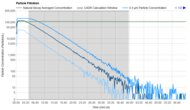
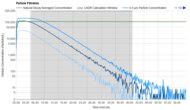
A HEPA-certified filter isn't necessarily a guarantee of good overall filtration performance. A HEPA grade filter will demonstrate good overall filtration efficiency, which is to say, a filter's ability to trap particles within a single exchange of airflow. However, filtration efficiency isn't the be-all and end-all indicator of filtration performance. Instead, it's merely a component of a more comprehensive metric, that being the clean air delivery rate (CADR), which measures how quickly an air purifier can pull pollutants from the air.
Another key component of CADR is airflow, which measures how much air passes through a filter. This factor has an inverse relationship with filtration efficiency: the higher the filtration efficiency, the more restrictive the filter, and the lower the airflow.
A HEPA-rated unit with high filtration efficiency but low airflow might trap a significant amount of pollutants during a single air exchange in a room, but it also restricts its use to a relatively small area because only a small amount of air is filtered. A non-HEPA air purifier with lower filtration efficiency but higher airflow might not be as effective in capturing pollutants on its first pass, but it'll be able to filter the air multiple times within the same span as the latter. Each pass filters out more and more of the remaining pollutants from the air, meaning it won't take long for it to reach parity with a HEPA-rated unit.
All Reviews
Our recommendations above include some of the best HEPA filter air purifiers. We factor in price, visitor feedback, and availability.
That said, there's no single best option that'll suit everybody; your needs will depend on your budget, the size of your living space, your tolerance for operating noise, and whether you like having a device with convenience features like Wi-Fi connectivity. If you'd like to choose for yourself, here's the list of all the air purifiers with HEPA filters we've tested.


