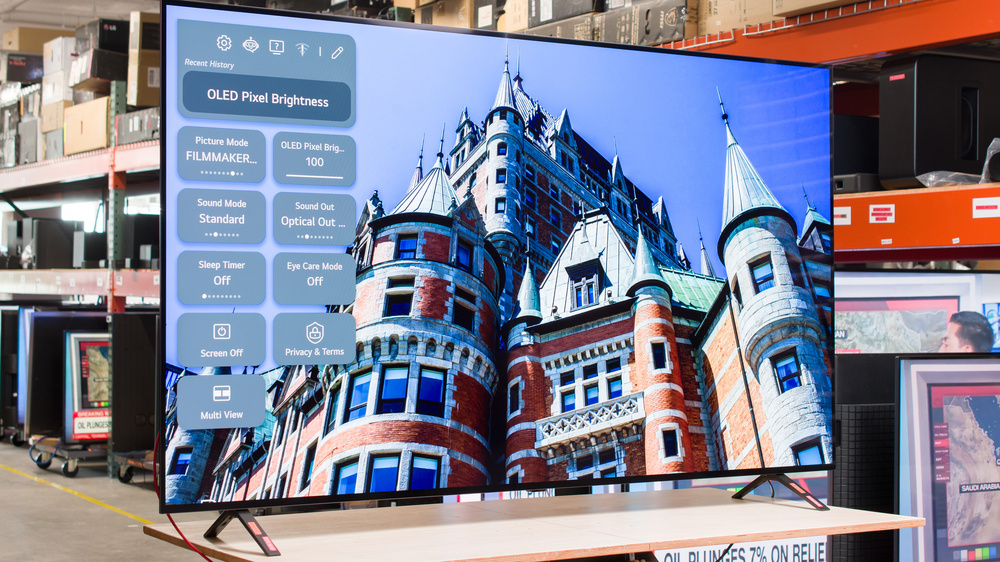
The LG B5 OLED is LG's entry-level TV in their 2025 OLED lineup. It's the direct replacement of the LG B4 OLED and sits below the LG C5 OLED. Like the C5, it uses a traditional WOLED panel instead of the more advanced primary RGB tandem panel found in the LG G5 OLED. Powered by LG's α8 AI Processor 4K Gen2 image processor, there's very little difference in features or specs over the 2024 version. It has four HDMI 2.1 bandwidth ports, which support up to 4k @ 120Hz with VRR for gaming, and like most LG TVs, it supports both HDR10 and Dolby Vision, but not HDR10+. We bought and tested the 77-inch version, but it's also available in 48, 55, 65, and 83-inch models.
Our Verdict
The LG B5 is a great TV for any usage, but like most OLEDs, it looks best in a dark room. Unfortunately, the set isn't bright enough and doesn't have the reflection handling needed to tame a sun-drenched room, so it's best suited for a moderately lit environment. That said, it really shines in home-theater conditions, where its vibrant colors, perfect blacks, and excellent out-of-the-box accuracy deliver a true reference-level picture. The TV is also an outstanding choice for gaming: all four HDMI ports support 4k @ 120 Hz, VRR, and input lag is impressively low, so motion stays razor-sharp and responsive. Finally, its OLED panel maintains color and contrast accuracy even when viewed from sharp angles, making it a dependable option for watching movies or sports with a group.
Near-infinite contrast ratio for perfect blacks with no blooming around bright highlights.
Incredibly wide viewing angle for a consistent image from the sides.
Colors are vibrant, lifelike, bright, and accurate.
Direct reflections are distracting.
Lacks the SDR brightness needed to overcome glare in a bright room.
The LG B5 is a great TV for home theater use. Like all OLEDs, it looks fantastic in reference conditions, with no distracting halo effect around bright highlights, and perfect inky blacks that give depth to the image like no other panel type can. It's also very accurate in both SDR and HDR, even without a professional calibration, ensuring most content is displayed the way the creator intended. On the other hand, due to its quick response time, there's noticeable stutter, especially in slow panning shots. Its peak brightness in HDR is also a bit lacking, so bright specular highlights aren't as bright as they should be, and very bright scenes are dimmed considerably by the TV's aggressive automatic brightness limiter.
Near-infinite contrast ratio for perfect blacks with no blooming around bright highlights.
Colors are vibrant, lifelike, bright, and accurate.
Does a very good job upscaling and cleaning up low-quality content.
Very noticeable stutter due to the TV's fast response time.
The LG B5 is an alright choice for a bright room. It's limited by its relatively low peak brightness, which can't always overcome glare in a bright room, especially with bright content like sports. Direct reflections are also a bit distracting, so you should avoid placing it directly opposite any windows or lights for the best results. On the flip side, light hitting the panel has very little impact on the overall picture quality, so assuming it's bright enough to see the screen, you'll still get nearly the same deep blacks and vibrant colors you would in a darker room.
Blacks remain deep and colors stay vibrant in a room with ambient lighting.
Direct reflections are distracting.
Lacks the SDR brightness needed to overcome glare in a bright room.
The LG B5 is a decent TV for watching sports. Fast action is clear and easy to see thanks to its incredibly quick response time and clean color transitions. It processes low resolution or low bitrate feeds well, great for streaming from less-than-ideal sources. Like all OLEDs it has a very wide viewing angle, making it a good choice for wide seating arrangements. Unfortunately it's not a very bright TV in SDR, so it can't always overcome glare in a bright room, especially from direct light sources.
Incredibly wide viewing angle for a consistent image from the sides.
Nearly instantaneous pixel transitions for no noticeable blur behind fast motion.
Colors are vibrant, lifelike, bright, and accurate.
Does a very good job upscaling and cleaning up low-quality content.
No transition artifacts.
Direct reflections are distracting.
Lacks the SDR brightness needed to overcome glare in a bright room.
The LG B5 is an excellent TV for gaming. It delivers an incredibly responsive gaming experience overall, with low input lag and a nearly instantaneous response time. It has a great selection of gaming features, including support for up to 4k @ 120Hz on all four inputs, with VRR to help reduce tearing. Of course, picture quality is also important when gaming, and the B5 is no slouch, with a bright and vibrant panel when gaming in HDR.
Nearly instantaneous pixel transitions for no noticeable blur behind fast motion.
Colors are vibrant, lifelike, bright, and accurate.
The LG B5 has decent brightness. In SDR, it's good enough to overcome glare in a moderately lit room with most content, but it struggles with bright content like sports. Small specular highlights in HDR pop out well enough to deliver an impactful HDR experience, but very bright scenes are dimmed considerably by the TV's aggressive automatic brightness limiter.
Lacks the SDR brightness needed to overcome glare in a bright room.
Since the LG B5 is an OLED, it has perfect black levels. Blacks are deep and inky when viewed in a dark room, with no backlight glow or haloing around bright parts of the scene.
Near-infinite contrast ratio for perfect blacks with no blooming around bright highlights.
The LG B5 has very good colors. It has fantastic color accuracy out of the box in both HDR and SDR, so you don't need to worry about getting it professionally calibrated. It also displays a wide range of colors in HDR. Like most WOLED panels, though, bright colors are washed out a bit, as it relies on the white subpixel to boost luminance.
Colors are vibrant, lifelike, bright, and accurate.
The LG B5 OLED has very good motion handling when watching all types of content. There are no transition artifacts at all, so colors are consistent, and there's no ghosting during fast-paced scenes and when watching sports. The TV only has some subtle judder with 25p content via a 60p signal, like when watching some European shows and movies from an older streaming device. Outside of that, there's no distracting judder or micro-judder. Unfortunately, there's stutter that's most noticeable during slow panning shots, but this is true of any OLED TV.
No transition artifacts.
Removes judder from most content.
No micro-judder in scenes with complex motion.
Perfect lighting zone transitions.
Very noticeable stutter due to the TV's fast response time.
The LG B5 is incredibly responsive when gaming. It has incredibly low input lag, and like all OLED displays, it has nearly instantaneous pixel transitions, so there's no noticeable blur behind fast motion.
Nearly instantaneous pixel transitions for no noticeable blur behind fast motion.
Note: We're in the process of improving our tests related to image processing, but this score should give you a general idea of how a TV performs overall with its image processing capabilities.
The LG B5 has very good image processing capabilities. Low-quality content is smoothed out well, nearly eliminating macro blocking and pixelization in low-bitrate streams without removing fine details. It also upscales low-resolution content well, with no excess image sharpening. Finally, it processes HDR signals well, with superb EOTF tracking and excellent gradient handling, but there's some noticeable posterization in certain shades.
Does a very good job upscaling and cleaning up low-quality content.
Exceptional HDR brightness accuracy.
Performance Usages
Changelog
-
Updated Mar 11, 2026:
We added text to our new Cinematic Motion Handling performance usage and our new Transition Artifacts and Stutter Reduction Via Interpolation test sections after converting the review to TV 2.2.
- Updated Mar 10, 2026: This review has been updated to TV 2.2. We've added new sections for Transition Artifacts and Stutter Reduction Via Interpolation, and updated the way we test Stutter. Additionally, we removed the 'Broken' disclaimer from our Motion Handling usage.
- Updated Jan 20, 2026: We added text to the new Micro-Judder section and refreshed the text in the updated Judder and Response Time Stutter sections after converting the review to TV 2.1.
-
Updated Oct 07, 2025:
We bought and tested the LG QNED92A, and added a comparison in the HDR Brightness section.
Check Price
Differences Between Sizes And Variants
We tested the 77-inch LG B5 (OLED65B5PUA), and the results are also valid for the 48-inch, 55-inch, 65-inch, and 83-inch models. There's also a variant of this TV called the LG B5A that's sold primarily at club stores like Sam's Club and Costco. There's absolutely no difference between them, but the club version usually comes with a longer warranty. Unlike the B4, the 83-inch model is the same as the smaller sizes.
| Size | US Model |
|---|---|
| 48" | OLED48B5PUA |
| 55" | OLED55B5PUA |
| 65" | OLED65B5PUA |
| 77" | OLED77B5PUA |
| 83" | OLED83B5PUA |
Our unit was manufactured in Mexico in May 2025, and you can see a photo of its label here.
Popular TV Comparisons
The LG B5 offers excellent value, delivering similar picture quality to its bigger siblings like the LG C5 OLED and LG G5 OLED, but at a more accessible price. It's an excellent entry‑level choice for anyone wanting to upgrade their home theater or gaming setup, delivering solid features and performance without the steep cost of high‑end gear. On the other hand, whereas the C5 and G5 both pushed OLED tech to new heights, the B5 is relatively unchanged from last year's LG B4 OLED, so there's very little reason to upgrade. If you can find the older model for less, you're not missing out on anything. You could also shop for one of the QD-OLED variants of the Samsung S85F OLED, namely the 55 and 65-inch models, as they're noticeably more colorful than the LG, as well as being brighter in SDR.
For more options, check out our recommendations for the best OLED TVs, the best movie TVs, and the best Nintendo Switch 2 TVs.
The LG C5 OLED is a noticeable upgrade over the LG B5 OLED. The C5 is far brighter in HDR and SDR, and this in turn also makes it the most colorful of the two TVs. The C5 is capable of gaming at up to 4k @ 144Hz on all of its ports, while the B5 is limited to 120Hz. Plus, the C5 has slightly better image processing.
While the two TVs are very similar, the LG C4 OLED is better than the LG B5 OLED. The C4 is brighter in HDR and SDR, handles ambient reflections better, and is capable of gaming at up to 4k @ 144Hz on all ports; the B5 is limited to 120Hz. Otherwise both TVs have the same set of features, although the B5 supports the 6Ghz Wi-Fi band, which the C4 doesn't have.
The LG B5 is a much better TV than the TCL QM7K. The B5 delivers much better dark room performance, with perfect inky blacks that give the image more depth, and perfect uniformity with no distracting haloing around bright highlights or subtitles. The LG is also better for gaming thanks to its nearly instantaneous response time, so there's no motion blur around fast-moving objects. The TCL TV gets quite a bit brighter, though, so it's a slightly better choice if you're in a bright room.
The Samsung S85F OLED is a bit better than the LG B5 OLED, mostly because it is a bit brighter in SDR, and is noticeably more colorful. The Samsung also handles reflections far better than the LG, but this comes at the cost of noticeable ambient black level raise, giving the screen a grey-pink tint in brighter environments. Finally, the Samsung has an even wider viewing angle than the already excellent LG, with no green tint. The LG does have some notable advantages, such as better HDR pre-calibration accuracy, and better low-quality content smoothing; the LG also supports the 6Ghz Wi-Fi band, while the Samsung is limited to the 2.4 and 5Ghz bands.

We buy and test dozens of TVs yearly, taking an objective, data-driven approach to deliver results you can trust. Our testing process is complex, with hundreds of individual tests that take over a week to complete. Most of our tests use specially designed test patterns that mimic real content, but we also use the same sources you have at home to ensure our results match the real-world experience. We use two main tools for our testing: a Colorimetry Research CR-100 colorimeter and a CR-250 spectroradiometer.
Test Results

for pictures & test results

for pictures & test results

for pictures & test results

The LG B5 has decent peak brightness in HDR, but it's a step down from the LG C5 OLED. Small highlights stand out enough for impactful HDR, but large bright scenes are dimmer. Mini LED TVs like LG's 2025 flagship LG QNED92A are a better choice for watching very bright content, like hockey.
The results above are with the TV in its most accurate mode with 'Dynamic Tone Mapping' disabled. Enabling this setting usually increases the brightness in some scenes but sacrifices accuracy, but in the case of the B5, it actually decreases the peak brightness of our real scene measurements:
- Hallway Lights: 735 cd/m²
- Yellow Skyscraper: 483 cd/m²
- Landscape Pool: 288 cd/m²
for pictures & test results

for pictures & test results

for pictures & test results

Switching to the Game Optimizer picture mode noticeably decreases HDR brightness, so highlights don't pop out as much.
The results above are with the TV in its most accurate mode with 'Dynamic Tone Mapping' disabled. Just like in Filmmaker Mode, enabling this setting here slightly decreases the peak brightness of our real scene measurements:
- Hallway Lights: 547 cd/m²
- Yellow Skyscraper: 382 cd/m²
- Landscape Pool: 244 cd/m²
The LG B5 has mediocre peak brightness in SDR. While most content is bright enough to overcome glare in a moderately lit space, you'll need to switch to one of the less accurate picture modes for a bright room. Even then, really bright content, like most sports, doesn't get bright enough to overcome glare.
for pictures & test results

The TV has a nearly infinite contrast ratio, giving it perfect contrast. Due to OLED's self-lit pixels, it displays bright highlights next to perfect inky blacks, making it very impressive in a dark room.
for pictures & test results

Since OLEDs don't use lighting zones and instead have individual pixels that can be lit up to their maximum brightness next to pixels that are turned off, there's no haloing when bright elements are surrounded by deep blacks.
for videos & test results

The LG B5 is an OLED without a backlight, so its self-lit pixels give it the same performance as a TV with perfect local dimming and no zone transitions. We still film the zone transition video so you can see how it compares to an option with local dimming.

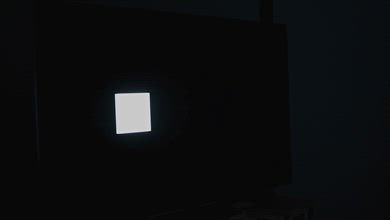

for pictures & test results

Because OLEDs can turn off individual pixels, the TV has perfect black uniformity with no halo effect around bright objects.
for pictures & test results

for pictures & test results

The LG B5 has excellent color volume in SDR. It has full coverage of the BT.709 color space used with the majority of SDR content, and decent coverage of the wider BT.2020 color space. Unlike the LG B4 OLED, colors aren't desaturated at higher lightness levels, suggesting that LG isn't driving the white subpixel as much.
| Volume ΔE³ | DCI-P3 Coverage |
BT.2020 Coverage |
|---|---|---|
| L10 | 95.15% | 65.17% |
| L20 | 97.67% | 67.52% |
| L30 | 98.42% | 69.02% |
| L40 | 98.67% | 71.15% |
| L50 | 98.69% | 71.98% |
| L60 | 98.60% | 72.14% |
| L70 | 98.38% | 70.70% |
| L80 | 98.04% | 68.64% |
| L90 | 97.65% | 69.89% |
| L100 | 97.98% | 92.01% |
| Total | 98.30% | 71.17% |
for pictures & test results

for pictures & test results

The color volume in HDR is good. The TV displays dark saturated colors nearly perfectly, thanks to its superb contrast. Brighter scenes don't fare quite as well, as it doesn't display colors nearly as bright as pure white in HDR.
for pictures & test results

for pictures & test results

for pictures & test results

This TV has excellent pre-calibration accuracy in SDR in the most accurate mode. The white balance is a bit off across the board, but not noticeably so, and the overall color temperature is very close to ideal. Gamma fluctuates across scenes but remains close to our 2.2 target, and color accuracy is amazing.
for pictures & test results

for pictures & test results

for pictures & test results

The LG B5 is very easy to calibrate, and although most people won't notice the difference, it's nearly perfect after calibration.
See our full calibration settings.
for pictures & test results

for pictures & test results

The LG B5 has fantastic accuracy in HDR before calibration. Its white balance is fantastic, with very few noticeable errors, and the overall color temperature is nearly perfect. The color accuracy is excellent, but there are some mapping errors throughout.
for pictures & test results

for pictures & test results

There's very little benefit to calibrating this TV in HDR. The white balance and color accuracy are slightly better after calibration, but it's not a significant difference and the errors are still noticeable.
for pictures & test results

The TV displays most content at the brightness level the content creator intended due to its fantastic PQ EOTF tracking. With content mastered at 600 or 1000 nits, there is a gradual roll-off near its peak brightness to maintain some detail in bright highlights. With content mastered at 4000 nits, the TV starts rolling off at a lower brightness level, as it preserves gradation over boosting highlights.
for pictures & test results

The TV has very good low-quality content smoothing. It does a great job smoothing out macro blocking and pixelization without removing most fine details.
for pictures & test results

The TV does a very good job at upscaling low-resolution content like DVDs or lower-resolution streams. Details are clear enough, but very fine details are hard to make out.
Sharpness processing was calibrated with no over-sharpening for low-resolution content, with the following settings:
- Sharpness: 16
- Super Resolution: High
for pictures & test results
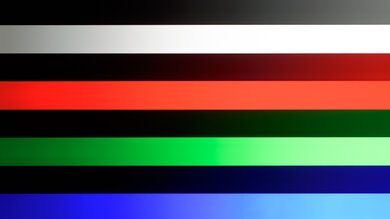
The TV has very good HDR native gradient handling. There's some noticeable banding in dark grays and bright greens, but all other colors have barely any noticeable banding or posterization.
This TV doesn't have the issues with banding and diagonal lines that affect the LG C5 OLED and the LG G5 OLED.
The TV's input lag when using the Game Optimizer picture mode is very low across the board, ensuring a very responsive gaming experience.
Its input lag is a lot higher outside of its gaming mode, so there's a noticeable delay when navigating menus using an external player.
Below are some additional input lag measurements.
4:3 @ 60Hz:
- 640x480: 12.7 ms
- 800x600: 34.9 ms
- 1024x768: 13.5 ms
SDR Filmmaker Mode with the Game Optimizer setting Enabled and the Input Label Set to 'HDMI':
- 60Hz: 21.8 ms
- 120Hz: 13.3 ms
HDR Filmmaker Mode with the Game Optimizer setting Enabled and the Input Label Set to 'PC':
- 60Hz: 23.0 ms
- 120Hz: 12.8 ms
The LG B5 supports all common formats up to 120Hz. It displays chroma 4:4:4 properly with any supported resolution, which is important for clear text from a PC.
There are two settings you can use to passthrough proper chroma 4:4:4. The first is to change the input label to 'PC.' The second is to enable the '4:4:4 Passthrough' setting in the 'HDMI Settings' menu.
The LG B5 supports all three types of variable refresh rate (VRR) technology to reduce screen tearing. It works across a wide range of refresh rates, including sources that support Low-Framerate-Compensation (LFC), which ensures that your games remain nearly tear-free even when the refresh rate drops below the panel's minimum refresh rate.
for pictures & test results
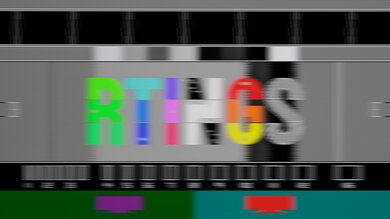
for pictures & test results

No surprises here, the LG B5 delivers incredibly clear motion at the maximum refresh rate of 120Hz. There's a tiny bit of overshoot in transitions from black to anything else, but it's minor and not really noticeable.


for pictures & test results

for pictures & test results

Dropping down to 60Hz doesn't change the TV's motion handling much. Most transitions are still extremely quick, but there's still some noticeable overshoot when it changes from black. There's also noticeable persistence blur due to the nature of a 60Hz refresh rate.
for pictures & test results

The TV is fully compatible with everything the PS5 offers, like 1440p @ 120Hz and 4k @ 120Hz, as well as HDMI Forum VRR. It also supports Auto Low Latency Mode, so it automatically switches to Game Optimizer to get the lowest input lag.
for pictures & test results

The TV is fully compatible with everything the Xbox Series X|S offers, including 1440p @ 120Hz, 4k @ 120Hz, HDMI Forum VRR, FreeSync Premium Pro, and Dolby Vision gaming. It also supports Auto Low Latency Mode, so it automatically switches to Game Optimizer to get the lowest input lag.
for videos & test results
for pictures & test results

for pictures & test results
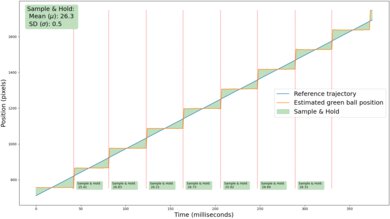
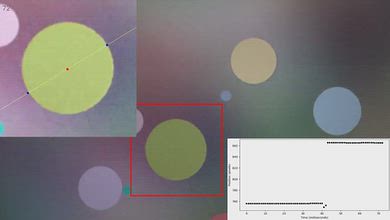
Unfortunately, due to the TV's nearly instantaneous pixel response time, there's stutter with low frame rate content, which is most noticeable during slow panning shots.
for videos & test results
for pictures & test results

for pictures & test results
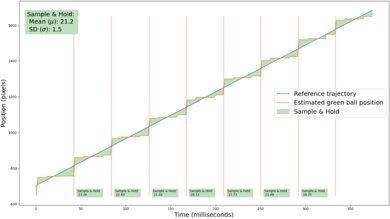
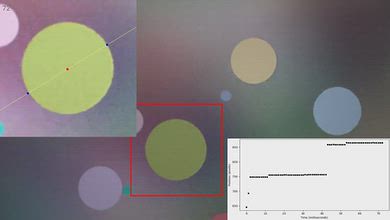
The LG B5 OLED does a very good job of interpolating 24fps content to 30fps. The motion interpolation feature has outstanding consistency, but motion still lacks some fluidity. The TV's nearly instantaneous response time causes stutter that minimal motion interpolation can't fully eliminate. As a result, slower camera movements in low frame rate content are still a bit choppy.
for pictures & test results
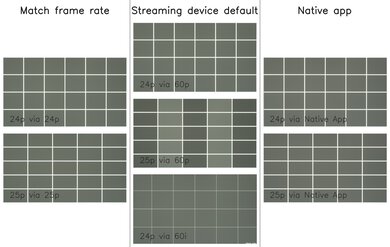
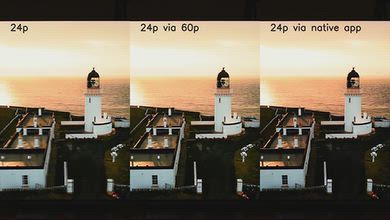
The LG B5 removes 24p and 25p judder from native apps and external devices that send a 24Hz or 25Hz signal, like an Apple TV with the 'Match Frame Rate' feature enabled. The TV also properly removes judder from 24p content that's being sent to it in either 60p or 60i. However, it doesn't completely remove 25p judder from 60p signals, which causes motion to look a bit jittery if you're watching certain European content from an older streaming device.
To remove judder on this TV, the Real Cinema setting must be enabled. Unfortunately, this setting is locked when OLED Motion Pro (BFI) is enabled, so movies and TV shows aren't judder-free when BFI is enabled, since the BFI feature only flickers at 60Hz.
for videos & test results
for videos & test results
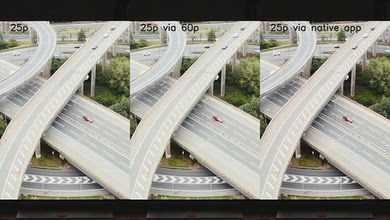
This TV is completely free from micro-judder with all 24p and 25p content, so motion in complex scenes is mostly smooth.
for pictures & test results

for pictures & test results

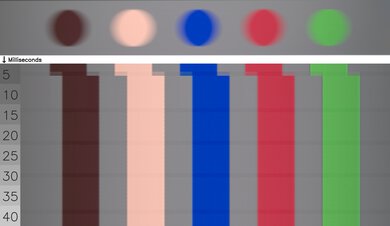
This TV has a superb cinematic response time. It's much slower transitioning to or from dark shades, so dark scenes don't look quite as good as bright ones.
for pictures & test results
for pictures & test results
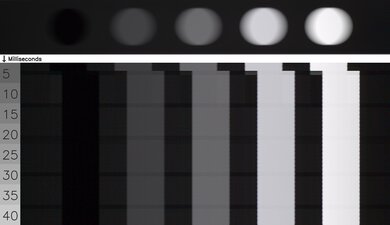
The LG B5 OLED is free from any transition artifacts when watching movies, shows, and sports. There isn't any ghosting or unwanted intermediate colors during transitions, so colors remain consistent and pure, even during fast-paced scenes and sports.
for pictures & test results

This TV doesn't have a traditional backlight and doesn't use pulse-width modulation (PWM) to dim each pixel, but it's not completely flicker-free. There's a slight dip in brightness that corresponds to the TV's refresh rate. This differs from the PWM flicker on TVs with LED backlights and occurs on every OLED display on the market. It's not noticeable, and most people won't be bothered by this, but it can still bother people who are extra sensitive to flicker.
for pictures & test results
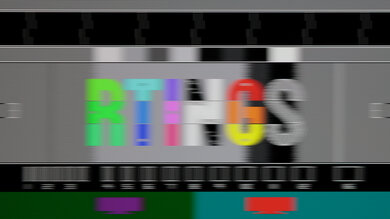
for pictures & test results
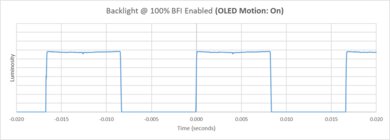
It has an optional black frame insertion (BFI) feature that reduces the appearance of persistence blur caused by the TV's nearly instantaneous response time. It can only insert black frames at a 60Hz refresh rate.


for pictures & test results

for pictures & test results

The TV handles mixed lighting conditions quite well. It reduces the intensity of ambient lights to a good degree, but unfortunately, it does so with some diffraction artifacts present on the screen.
for pictures & test results

The TV's ambient color saturation is good in brighter environments; it loses some of the pop in its high-luminance colors, but, overall, it's still colorful.
for videos & test results
for pictures & test results

for pictures & test results

for pictures & test results

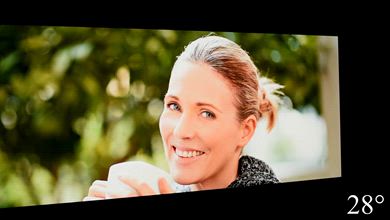
The TV's viewing angle is excellent, although far from perfect. Its colors start shifting rather early when you move to the sides, giving the scene an increasingly green hue. At wider angles, the entire set of primary colors lose some of their vibrancy. Still, this is a great pick for a wide seating arrangement.
for pictures & test results

for pictures & test results

The TV's gray uniformity is good. Like on many OLEDs, there are some faint vertical lines, which are more noticeable in certain scenes, but overall, you'd be hard-pressed to notice them from a normal viewing distance.
for pictures & test results

for pictures & test results

The TV uses a WOLED panel with a RWBG pixel structure where all four pixels are never lit at the same time. Due to its subpixel layout, it has minor issues with displaying text on Windows since ClearType isn't well optimized to non-RGB subpixel layouts, but most users won't be bothered by this.
The white subpixel does an excellent job helping the TV display bright whites, but it dilutes the color purity of greens and reds.
Unlike the LG C5 OLED and LG G5 OLED, this model doesn't have any diagonal lines as a result of dithering.
for pictures & test results

for pictures & test results

The LG B5 supports the full 48Gbps bandwidth of HDMI 2.1 on all four HDMI ports. This allows you to take full advantage of multiple high-bandwidth devices, such as if you own multiple current-gen consoles and a high-end gaming PC.
The LG B5 OLED TV passes through all Dolby Digital options. However, it doesn't support any DTS audio formats commonly used on physical media. LG has supported DTS on all of their 2023 and 2024 OLED models, but they've dropped support across their entire lineup in 2025.
Our unit has intermittent issues when playing some Dolby Atmos content. Even though the TV displays "Atmos" in the info banner, sometimes audio would simply not play. A power cycle sometimes resolved the issue, but it would then come back, forcing us to power cycle the TV again. Factory resets did not solve the issue.
for pictures & test results

The LG B5 OLED has a very sleek and modern design, very similar in tone to 2024's LG B4 OLED.
for pictures & test results

The feet hold the TV very well, and there is minimal wobble when it's pushed on. The feet lift it about 3.4 inches above the table, so pretty much any soundbar will fit underneath without blocking the screen. It comes with two plastic clips that can be attached to the feet for cable management.
Footprint of the 77-inch stand: 140.3" x 12.6"
for pictures & test results

The LG B5 OLED has a dark gray metal back panel with a design reminiscent of the LG C5 OLED. It also has a matching dark gray plastic central panel that houses the inputs. Some of the inputs face the side and are close enough to the edge of the TV that they are accessible when it's wall-mounted, but the back-facing inputs are nearly impossible to reach if you have it mounted to the wall. If you use a mount like LG's Slim Wall Mount that mounts the TV very close to the wall, the backports are unusable unless you use a 90-degree HDMI adapter. Since one of those back-facing HDMI ports is the eARC port, this really limits you if you want to wall-mount the TV with a soundbar plugged in.


for pictures & test results

The LG B5 OLED's two feet do the trick and look good, and the new LG C5 OLED inspired back is a welcome addition. Our unit had two dead pixels on the panel, but aside from that, there are no quality control issues with the TV, and it's built solidly.
for pictures & test results

The LG B5 OLED TV runs the 2025 version of LG's proprietary smart interface, webOS. The interface supports user profiles, so you can customize the home page for different users. LG promises at least four years of webOS updates on their TVs, and you get updated versions of the operating system once a year.
Sometimes, the TV kept default to PC mode, even after setting the input label to HDMI. We found that we could get around the issue by setting the label to HDMI twice, but it would still sometimes stay stuck in PC mode.
for pictures & test results

There are two settings in the 'Home Settings' menu, namely the 'Home Promotion' and 'Content Recommendation' settings. These settings remove the top banner ads and suggested content from the home screen. This gives your home screen a clean look, but there's no way to remove ads from the apps page.
for pictures & test results

The TV comes with LG's new 2025 Magic Remote. Like the old version, it can be used as a pointer, or you can use the traditional buttons to control it. Unfortunately, LG ditched the number pad on this new remote, so you can't assign quick launch shortcuts anymore. There's also no dedicated input button, so you have to use the home dashboard to switch inputs.


for pictures & test results

- Remote (with 2x AAA batteries)
- User manuals
- Cable management clip
The TV consumes a maximum of 230W of power, which is a bit more than the 214W maximum that the 2024 LG B4 OLED consumes, although we tested the 65-inch B4, so the comparison isn't 1:1.
for pictures & test results

The LG B5 OLED TV has a mediocre frequency response. The TV speakers don't produce much bass, but the sound profile is well-balanced enough that the dialogue is clear, especially at lower volume. Unfortunately, the speakers don't get very loud, and there are compression and pumping artifacts at maximum volume.