
The Samsung U8000F is a very basic, entry-level TV released in 2025 that sits above the Samsung U7900F. The direct replacement to the Samsung DU8000, this 4k TV is powered by Samsung's Crystal Processor 4k and features an updated design over the 2024 model with a metal back. It's very basic, with a limited selection of inputs, a 60Hz refresh rate, and no local dimming. We bought and tested the 70-inch version, but it's available in a range of sizes from 43 up to 85 inches.
Our Verdict
The Samsung U8000F is a sub-par TV overall. It's not very bright, making it best-suited for a moderately-lit room with just a bit of light. It's not great in the dark, either, due to its fairly low contrast and lack of local dimming. Gamers will appreciate its low input lag and VRR support, but the latter isn't very effective as its 60Hz refresh rate means VRR won't work most of the time. It has poor motion handling, with a slow response time resulting in blurry motion in sports and gaming, and the screen degrades rapidly when viewed at an angle, so it's not good for a wide seating arrangement.
Excellent color accuracy in SDR out of the box.
Can't reduce the intensity of direct, mirror-like reflections.
Mediocre screen uniformity.
Not bright enough to overcome glare in a bright room.
The Samsung U8000F is a disappointing choice for use in a home theater. It has poor black levels, with just decent native contrast and no local dimming, so the screen looks washed out in most scenes. Colors aren't very bright or vibrant, and it's nowhere near bright enough to deliver an impactful HDR experience. It has okay processing, though, with excellent EOTF tracking and good gradient handling, but it doesn't support Dolby Vision HDR or DTS audio formats. Finally, it has disappointing motion handling, as it can't remove judder from 60Hz sources and there's a noticeable red shift around light skin tones.
Excellent color accuracy in SDR out of the box.
Mediocre screen uniformity.
Can't smooth out macro blocking and pixelization in low quality content.
Too dim to deliver an impactful HDR experience.
No local dimming.
Noticeable stutter in slow panning shots.
Noticeable color artifacts in all content.
Can't remove judder from any 60Hz sources.
The Samsung U8000F is a disappointing choice for a bright room. It's simply not bright enough to overcome a lot of glare in a bright room, and with its poor reflection handling, bright mirror-like reflections are very distracting. On the plus side, ambient light has very little impact on picture quality, as black levels don't rise noticeably and the apparent color saturation remains the same.
Excellent color accuracy in SDR out of the box.
Can't reduce the intensity of direct, mirror-like reflections.
Not bright enough to overcome glare in a bright room.
The Samsung U8000F is inadequate for watching sports. It doesn't look good in a bright room, as it can't overcome glare and has very limited reflection handling. The image degrades rapidly when viewed at an angle, so it's a poor choice for a wide seating area, and the panel has mediocre uniformity, so uniform areas like the playing field are patchy and don't look good. It also has poor motion handling, as fast-paced action is very blurry. Finally, transitions aren't smooth, leading to blurry edges around fast-moving objects, and there's a noticeable red shift around quickly changing colors.
Excellent color accuracy in SDR out of the box.
Can't reduce the intensity of direct, mirror-like reflections.
Mediocre screen uniformity.
Blurry motion.
Noticeable color artifacts in all content.
The Samsung U8000F is a sub-par TV for gaming. It has low input lag and a few gaming features like VRR and ALLM, but it's limited to a 60Hz refresh rate. Games don't feel responsive due to its very slow response time, which results in blurry motion that doesn't look good. On the flip side, switching to the low-latency Game Mode has no impact on picture quality.
Very low input lag.
Game Mode has no impact on picture quality.
Blurry motion.
Narrow VRR range.
Limited to a 60Hz refresh rate.
The peak brightness of the Samsung U8000F is bad. It's far too dim to deliver an impactful HDR experience, as bright highlights don't stand out at all, and bright scenes are dull and lifeless. It's not bright enough to overcome glare in a bright room, either.
Too dim to deliver an impactful HDR experience.
Not bright enough to overcome glare in a bright room.
The Samsung U8000F delivers poor black levels. The panel's native contrast is decent, delivering somewhat deep blacks in very dark scenes. However, it lacks a local dimming feature, so the entire screen lights up whenever there's a bright highlight in the scene, causing all dark areas to appear washed out.
No local dimming.
The Samsung U8000F has mediocre colors. It has excellent color accuracy out of the box in SDR, with just a few noticeable issues, and decent accuracy in HDR. It has a very limited color gamut, though, as it can't even display the full range of colors used in most SDR content, and HDR content is dull.
Excellent color accuracy in SDR out of the box.
Colors are dull and muted.
The Samsung U8000F has disappointing motion handling when watching content. It can't remove judder from any 60Hz sources, like an older streaming device or cable TV box. There's also noticeable ghosting around the edges of fast-moving objects, and there's a noticeable red shift in quickly changing colors, especially around light skin tones. There's also noticeable stutter, especially in slow panning shots, and the motion interpolation is ineffective at improving it.
Ineffective motion interpolation feature.
Noticeable stutter in slow panning shots.
Noticeable color artifacts in all content.
Can't remove judder from any 60Hz sources.
The Samsung U8000F has mediocre responsiveness when you switch over to the dedicated Game Mode. It has low input lag in all supported modes, which is great, but games feel sluggish and motion looks bad due to its slow 60Hz refresh rate and poor response time.
Very low input lag.
Game Mode has no impact on picture quality.
Blurry motion.
Narrow VRR range.
Limited to a 60Hz refresh rate.
Note: We're in the process of improving our tests related to image processing, but this score should give you a general idea of how a TV performs overall with its image processing capabilities.
The Samsung U8000F has okay processing capabilities. It has excellent PQ EOTF tracking, ensuring most HDR content is displayed at the brightness level intended by the content creator (within the limits of its peak brightness). Gradients in HDR are also displayed well, with minimal banding and posterization. It has decent upscaling, but sadly it can't really do anything to clean up low quality content, so there's loads of macro blocking and pixelization when streaming content.
Decent upscaling.
Excellent EOTF tracking.
Good gradient handling.
Can't smooth out macro blocking and pixelization in low quality content.
Performance Usages
Changelog
-
Updated Jun 03, 2026:
We bought and tested the Samsung M80H and added a mention in the HDR Brightness section of the review.
-
Updated Mar 11, 2026:
We added text to our new Cinematic Motion Handling performance usage and our new Transition Artifacts and Stutter Reduction Via Interpolation test sections after converting the review to TV 2.2.
- Updated Mar 10, 2026: This review has been updated to TV 2.2. We've added new sections for Transition Artifacts and Stutter Reduction Via Interpolation, and updated the way we test Stutter. Additionally, we removed the 'Broken' disclaimer from our Motion Handling usage.
-
Updated Jan 21, 2026:
We bought and tested the Samsung U7900F, and added a comparison in the HDR Brightness section.
Check Price
Differences Between Sizes And Variants
We bought and tested the 70-inch Samsung U8000F, and these results are also valid for the 43, 50, 55, 58, 65, 75, and 85-inch models. All sizes offer the same picture quality and overall performance. Note that with Samsung TVs, the four letters after the short model code (FXZC in this case) vary between different retailers and regions, but there's no difference in performance.
Costco and Sam's Club sell a variant of this TV known as the Samsung U8000FD. This variant performs the same but comes with an extended warranty.
| Size | US Model |
| 43" | UN43U8000FFXZC |
| 50" | UN50U8000FFXZC |
| 55" | UN55U8000FFXZC |
| 58" | UN58U8000FFXZC |
| 65" | UN65U8000FFXZC |
| 70" | UN70U8000FFXZC |
| 75" | UN75U8000FFXZC |
| 85" | UN85U8000FFXZC |
Our unit was made in Mexico in March 2025.
Popular TV Comparisons
The Samsung U8000F is about as basic a TV as you can get in 2025. With no local dimming, low peak brightness, and poor colors, it's a relatively expensive entry-level model that delivers disappointing picture quality overall and has very few extra features. It pales in comparison to competing models from other brands that are even cheaper, but deliver much better performance, like the TCL QM6K or the Hisense U65QF.
For more options, check out our recommendations for the best TVs under $1,000, the best 65-inch TVs, and the best TVs for gaming.
The Samsung U8000F is a slightly better TV than the Samsung U7900F, but the differences are minor. They perform the same for the most part, but the U8000F gets quite a bit brighter, so while still not great, it can handle a bit more glare in a bright room. The U8000F also has an additional HDMI port, so it's slightly more versatile.
The Samsung Q7F 2025 is very slightly better than the Samsung U8000F. The Q7F gets a tiny bit brighter, it has better contrast, and it has slightly better contrast, but these three differences are very minor overall. Even though the U8000F is a lower-end model, it does have one minor advantage over the Q7F in that it supports VRR. Since it's limited to a 60Hz refresh rate, though, this feature isn't very useful for most people.
The Samsung U8000F is significantly better than the LG UA77. Although neither TV is a great choice for a dark room, the Samsung has a much higher native contrast ratio, so dark scenes aren't nearly as washed out and overblown. The Samsung is also far more accurate out of the box, so you don't need to worry about getting it calibrated if you care about creative intent. Other than that, these two TVs are fairly evenly matched.
The Hisense QD65NF is slightly better than the Samsung U8000F, but the differences are very minor. The Hisense gets a bit brighter, so it can handle a bit more glare if you're using it in a bright room. It also has slightly better contrast, so it delivers slightly deeper blacks if you're watching in a dark room. The Samsung TV, on the other hand, has a slight edge for gaming as it supports VRR to reduce tearing. It has a narrow VRR range, though, so it's not very effective.

We buy and test dozens of TVs yearly, taking an objective, data-driven approach to deliver results you can trust. Our testing process is complex, with hundreds of individual tests that take over a week to complete. Most of our tests use specially designed test patterns that mimic real content, but we also use the same sources you have at home to ensure our results match the real-world experience. We use two main tools for our testing: a Colorimetry Research CR-100 colorimeter and a CR-250 spectroradiometer.
Test Results
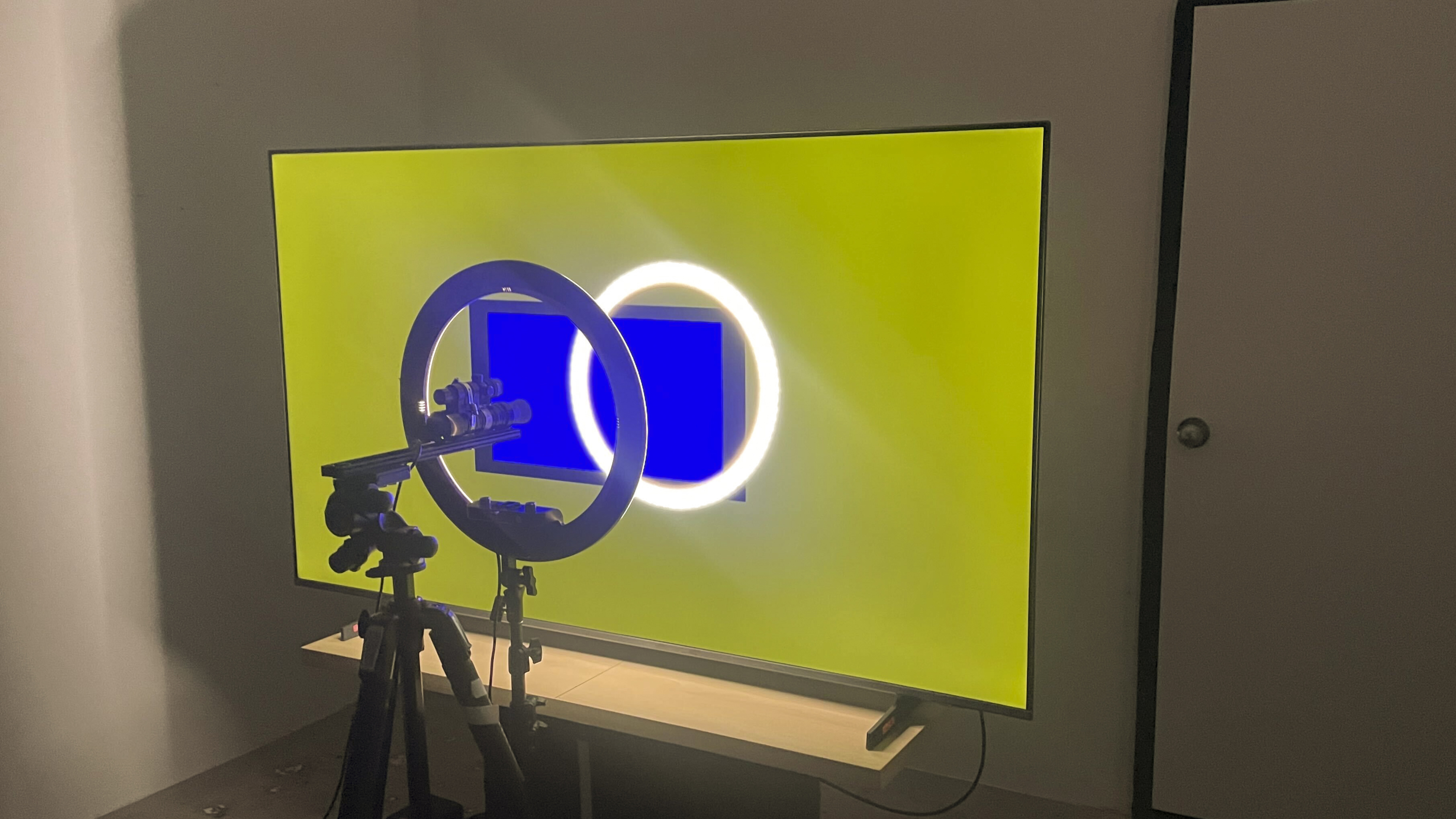
for pictures & test results

for pictures & test results

for pictures & test results

The Samsung U8000F has bad peak brightness in HDR. Although it's slightly brighter than the Samsung U7900F, it's still too dim to deliver an impactful HDR experience. Bright, specular highlights like the lamps in the hallway scene or the skyscraper in the cityscape don't stand out at all, and bright scenes look flat. It's not as bright as the newer Samsung M80H.
These measurements are in the Filmmaker Mode with 'HDR Tone Mapping' set to 'Static'. Below are the results with 'HDR Tone Mapping' set to 'Active', which doesn't do anything to increase peak brightness during most scenes.
- Hallway Lights: 249 cd/m²
- Yellow Skyscraper: 235 cd/m²
- Landscape Pool: 200 cd/m²
for pictures & test results

for pictures & test results

for pictures & test results

Switching to Game Mode slightly increases the peak brightness of some scenes, but it's not a noticeable difference. It's still far too dark to deliver an impactful HDR gaming experience. The TV's global dimming feature, also known as CE dimming, dims near-black scenes. This can't be disabled.
Results with 'HDR Tone Mapping' set to 'Active', which doesn't do much to increase peak brightness during most scenes.
- Hallway Lights: 273 cd/m²
- Yellow Skyscraper: 245 cd/m²
- Landscape Pool: 218 cd/m²
The peak brightness in SDR is poor. It's not bright enough to overcome glare in a bright room, so it's best suited for a light-controlled environment or at night in a moderately lit room. The TV's global dimming feature, also known as CE dimming, dims near-black scenes. This can't be disabled.
for pictures & test results

The Samsung U8000F has poor contrast. The VA panel's native contrast is good enough for dark scenes with no bright areas, but since it lacks local dimming, the entire screen lights up and looks slightly washed out once there's a bright area in the scene. Still, it's better than some comparably priced competing models like the LG UA77.
for pictures & test results

There's no local dimming feature, so there are no lighting zones. This means there's no haloing around bright elements against a dark background or subtitles, but the entire image looks gray and washed out.
for videos & test results

This TV doesn't have a local dimming feature, so it can't adjust the backlight of individual zones to brighten up highlights without impacting the rest of the image. This means that there are no distracting flickers or brightness changes as bright highlights move between dimming zones.

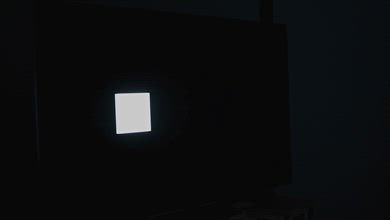

for pictures & test results

The Samsung U8000F has very good black uniformity. Blacks aren't very deep when there's a highlight in the scene like the test cross here, but they are relatively uniform, with just a few cloudy patches throughout.
for pictures & test results

for pictures & test results

This TV has poor color volume in HDR. It can't display the full range of reds or greens at any luminance level, resulting in a narrow color gamut. It can't display the full range of colors that make up the BT.709 color space used by most SDR content, let alone much of the wider DCI-P3 or Rec.2020 color spaces used in HDR.
| Volume ΔE³ | DCI-P3 Coverage |
BT.2020 Coverage |
|---|---|---|
| L10 | 79.94% | 58.87% |
| L20 | 78.75% | 56.76% |
| L30 | 78.24% | 56.39% |
| L40 | 77.17% | 56.79% |
| L50 | 76.12% | 55.62% |
| L60 | 71.12% | 50.78% |
| L70 | 64.21% | 41.38% |
| L80 | 62.82% | 38.74% |
| L90 | 62.88% | 38.64% |
| L100 | 76.86% | 53.88% |
| Total | 70.27% | 47.90% |
for pictures & test results

for pictures & test results

The HDR color volume is disappointing. It's limited by both the low peak brightness of the display and the narrow range of colors that it can show. Bright colors are dull and lifeless overall, and it can't display dark, saturated colors well, either.
for pictures & test results

for pictures & test results

for pictures & test results

This TV has excellent accuracy in SDR out of the box. The overall color accuracy and white balance are both great; there are just a few noticeable issues with saturated reds and blues. Gamma is a bit low, though, making everything slightly too dark. The color temperature is very close to the target.
for pictures & test results

for pictures & test results

for pictures & test results

The accuracy after calibration is fantastic, but it required a very aggressive calibration to achieve these results, and there are still some issues. Saturated reds and blues didn't improve much after calibration, but gamma, white balance, and the color temperature are nearly perfect.
See our full calibration settings.
for pictures & test results

for pictures & test results

The HDR accuracy before calibration is decent. There are noticeable mapping errors in all colors, but the white balance is great overall, with just a few issues in darker shades of gray. The color temperature is very cool, and it has a noticeable blue tint out of the box.
for pictures & test results

for pictures & test results

After calibration, the color accuracy in HDR is very good. However, it didn't improve much, as it's limited by the range of colors it can produce, so the color temperature is still quite cool. The white balance is fantastic, though, with just a few issues in very dark shades.
for pictures & test results

This TV has excellent PQ EOTF tracking. Most content tracks the creator's intent properly, but near-blacks are raised due to the low contrast ratio and lack of local dimming. There's a slight roll off near its peak brightness, preserving some gradients, but it's so dim that most bright details are lost. Content mastered at 4,000 nits performs a bit worse, as shadow details are raised a bit.
for pictures & test results

Unfortunately, this TV simply can't clean up low-quality content from streaming services. Macro blocking and pixelization artifacts are largely unchanged, but at least there's no loss of fine details.
for pictures & test results

This TV has decent upscaling, but the image looks a bit soft and small text can be hard to make out.
for pictures & test results
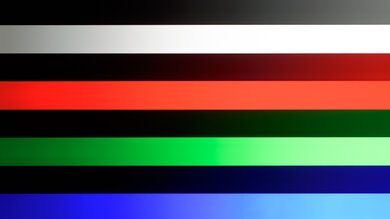
The Samsung U8000F has good gradient handling. There's some noticeable banding in dark shades of gray and green, but it's not too bad.
The Samsung U8000F has very low input lag, which helps deliver a more responsive gaming experience. Unlike most TVs, the input lag is relatively low even outside of the dedicated Game Mode, so if you want to enable a few of the extra processing modes, you can do so without significantly increasing the latency.
Unfortunately, this TV doesn't support refresh rates above 60Hz with any resolution. Chroma 4:4:4 signals are displayed properly, which helps with clear text from a desktop PC.
This TV supports all three types of VRR, but it's not very effective. Due to its low maximum refresh rate, the refresh rate range isn't wide enough to work with Low Framerate Compensation (LFC), so you'll see tearing if your framerate drops below 48Hz.
for pictures & test results
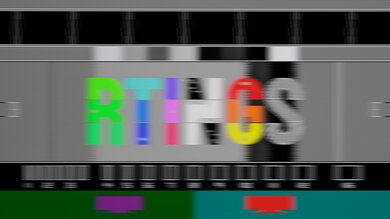
for pictures & test results

Unfortunately, this TV has a slow response time at the maximum refresh rate of 60Hz. It's especially bad in transitions from a very bright to very dark shade or vice-versa. Motion is blurry and it's hard to make out fine details.
This TV doesn't support a 120Hz refresh rate.
for pictures & test results

for pictures & test results

Unfortunately, this TV has a slow 60Hz response time. This is especially bad during transitions from a very bright to very dark shade or vice versa. Motion is blurry, and it's hard to make out fine details.
for pictures & test results

This TV is a 60Hz TV, so it only supports 4k @ 60Hz on the P55. It has Auto Low Latency Mode (ALLM), so it'll automatically switch to Game Mode when it detects a game being played, which gives you the lowest possible input lag for games.
for pictures & test results

This TV only supports 4k @ 60Hz Xbox Series consoles. It has Auto Low Latency Mode (ALLM), so it'll automatically switch to Game Mode when it detects a game being played, which gives you the lowest possible input lag for games. It doesn't support Dolby Vision.

for videos & test results
for pictures & test results

for pictures & test results
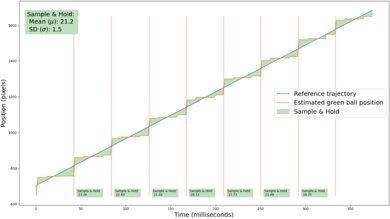
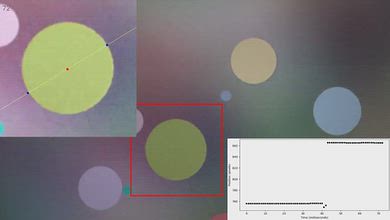
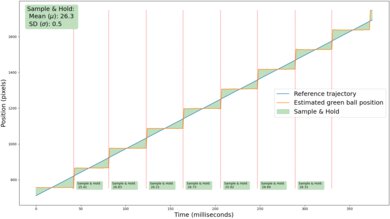
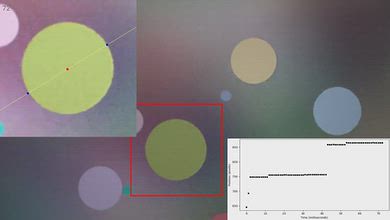
Unfortunately, the motion interpolation feature on this TV is completely ineffective at reducing stutter. It interpolates the first frame correctly but then immediately introduces judder instead, creating a very inconsistent frame time.
for pictures & test results
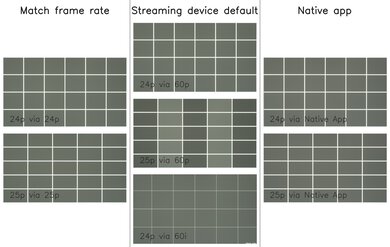
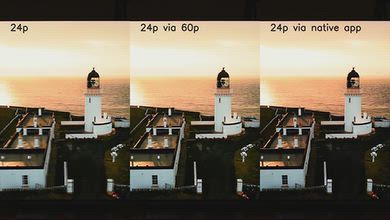
Judder is automatically removed from external sources that send a true 24p or 25p signal like a Blu-ray player, or the native apps. Unfortunately, it can't remove any judder from 60Hz sources like most cable TV boxes and older streaming devices that lack a Match Frame Rate feature.
for videos & test results
for videos & test results
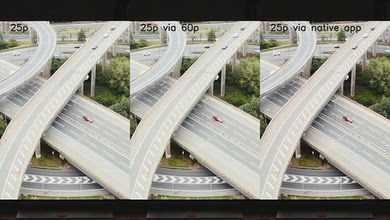
This TV is completely free from micro-judder with all 24p and 25p content, so motion in complex scenes is mostly smooth.
for pictures & test results

for pictures & test results

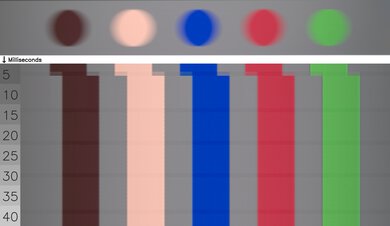
The Samsung U8000F has a very slow cinematic response time. While this helps to reduce stutter in low framerate content like movies, it introduces noticeable motion blur in fast content like sports.
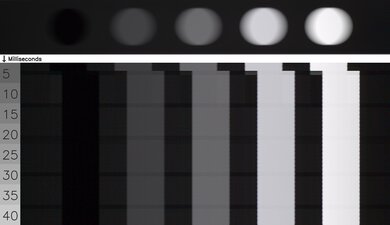
for pictures & test results

This TV uses pulse-width modulation (PWM) to dim its backlight, which introduces flicker that can bother people who are sensitive to it. The amount of flicker varies depending on what picture mode it's set to and what settings you're using.
- Movie: 120Hz below a Brightness setting of '20'
- Filmmaker: always flickers at 120Hz
- Dynamic: 120Hz below a Brightness setting of '20'
- Standard: 120Hz below a Brightness setting of '20'
- PC Mode: 120Hz below a Brightness setting of '20'
- Game Mode: 120Hz below a Brightness setting of '20'
for pictures & test results
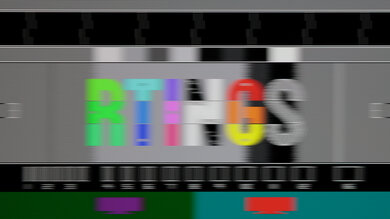
for pictures & test results
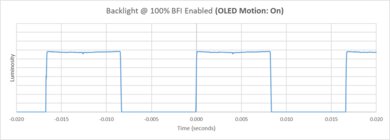
This TV supports backlight strobing, more commonly known as black frame insertion (BFI). The feature is designed to improve the appearance of motion by strobing its backlight and reducing the amount of persistence blur. The BFI feature flickers at 60Hz, and there's noticeable image duplication present.
for pictures & test results

for pictures & test results

The direct reflection handling on this TV is sub-par. Direct, mirror-like reflections are barely reduced in intensity, leading to an unpleasant viewing experience when you have bright lights or windows shining directly on the screen.


for pictures & test results

for pictures & test results

The total amount of reflected light is good overall. Bright lights are reflected back almost perfectly, but they're not spread out, and there are no noticeable diffraction artifacts.
for pictures & test results

The perceived color saturation in a bright room is mediocre. While ambient light has little impact on perceived color volume, it's low to begin with.
for videos & test results
for pictures & test results

for pictures & test results

for pictures & test results

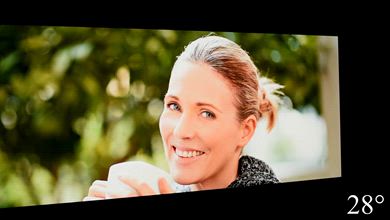
The Samsung U8000F has a mediocre viewing angle. The image degrades noticeably as you move off-center, as colors shift towards yellow due to the rapid shift in blue.
for pictures & test results

for pictures & test results

Unfortunately, the Samsung U8000F has mediocre gray uniformity. There are distracting dark bands on the sides of the screen, and the center is very patchy. It's slightly better in near-blacks, but the same issues are still noticeable.
for pictures & test results

for pictures & test results

This TV uses a BGR subpixel layout. It doesn't affect picture quality but can cause issues with text clarity in some applications when using it as a PC monitor. The SPD shows that it doesn't use quantum dot technology or a KSF phosphor, which explains the limited color volume.
This TV also has one of the most unusual panels we've ever seen. Each row of pixels is slightly shorter than expected for a 16:9 aspect ratio. When we place a 16:9 alignment grid over the pixels, it shows that it doesn't have the correct spacing. This difference is minor enough that it's not noticeable in real content, but it could be an issue for PC users.
for pictures & test results

for pictures & test results

This TV has a very limited selection of ports. All three HDMI ports are limited to HDMI 2.0 bandwidth, and along with the Samsung Q7F 2025, it's one of the only mainstream TVs released in 2025 that lacks an optical audio port.
This TV supports most Dolby Digital audio formats. Oddly, unlike other 2025 Samsung models, Dolby Digital Plus 7.1 passthrough works properly. Unfortunately, it doesn't support DTS formats, which is disappointing, as many Blu-rays use DTS for their lossless audio tracks.
Like all Samsung TVs, the Samsung U8000F doesn't support Dolby Vision, but it does support the similar HDR10+.
for pictures & test results

This TV looks okay, but it definitely has a less-premium design than higher-end Samsung models. The bezels are fairly thin, but there's a noticeable dead space between the sides of the screen and the first pixels.
for pictures & test results

The two feet are made of plastic and are set at the ends of the TV, with no alternative mounting position.
The footprint of the 70-inch stand is 44.0" x 10.2" x 2.9".
for pictures & test results

The inputs are housed in a central electronics box. Two of the inputs face straight out the back of the TV, so if you're planning on wall-mounting it you'll need a 90° adapter for the HDMI cables. Unfortunately, there's nothing to help with cable management.


for pictures & test results

This TV has mediocre build quality. The back of the TV is made of a cheap-feeling plastic, and it feels loose in the back. There are no significant issues with it except for the panel's odd aspect ratio.
for pictures & test results

The Samsung U8000F Series comes with the 2025 version of Samsung's proprietary Tizen OS but has a reduced feature set compared to more expensive models, so you don't get features like TV to Mobile or Ambient Mode+. The interface is a bit slow at times, but it's still easy to find content to watch.
for pictures & test results

Like most TVs, there are ads on the home screen. You can't disable them completely, although you can turn off targeted ads.


for pictures & test results

This TV has a mediocre frequency response. It can't get very loud, but the sound profile is well-balanced at moderate listening levels and dialogue is easy to understand.